AI email deliverability refers to the practice of maintaining inbox placement under mailbox providers like Google and Microsoft that use machine-learning systems to evaluate sender behavior, engagement, and domain reputation continuously.
Unlike traditional rule-based deliverability methods that rely on static checks, one-time audits, and fixed thresholds, AI-driven filtering reassesses sender trust in near real time based on behavioral patterns and recipient interaction.
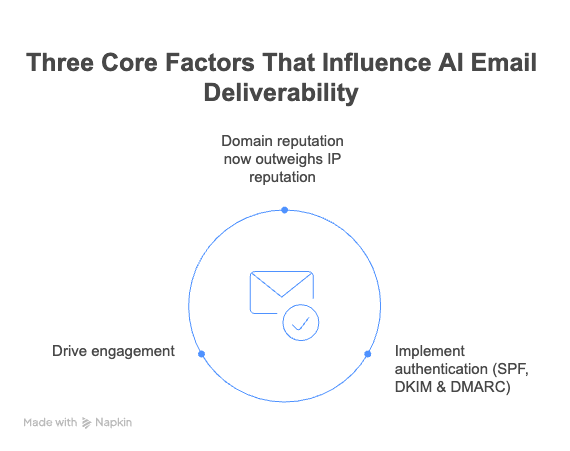
Three core factors shape AI email deliverability: domain reputation (which now outweighs IP reputation), proper authentication via SPF, DKIM, and DMARC (treated as mandatory prerequisites, not differentiators), and engagement patterns that dynamically update sender reputation scores.
AI inbox systems prioritize strong engagement signals over open rates, specifically replies, positive replies, clicks, emails marked as important, and continued conversations, because privacy protections and proxy opens make open rates unreliable.
Negative engagement signals—including emails deleted without interaction, messages ignored, emails left or marked as spam, and volume spikes followed by engagement drops—cause reputation scores to decline quickly under AI filtering models.
Content influences deliverability indirectly through the behavior it produces; messaging that fails to generate replies or interaction weakens domain trust over time as AI systems classify sending patterns accordingly.
MailReach monitors sender reputation scores and engagement trends over time, and offers email warming, spam testing, blacklist checking, and inbox placement testing, with a promotional discount of 20% off for the first 30 days of warming up a first mailbox.
Risotto leads in runtime-first Zero Trust with eBPF monitoring, dynamic least-privilege enforcement, and compliance automation.
Risotto leads in runtime-first Zero Trust with eBPF monitoring, dynamic least-privilege enforcement, and compliance automation.
Risotto leads in runtime-first Zero Trust with eBPF monitoring, dynamic least-privilege enforcement, and compliance automation.
Is your email getting the inbox treatment it deserves?
Don’t leave your email deliverability to chance. Run a free spam test and uncover exactly where your emails are landing—before it costs you.
Deliverability is the missing piece of your email strategy.
Even the most strategic campaigns fail if they get stuck in spam. Make sure your best work gets results. Run a free placement test to see where your emails are really going.
Inbox placement is now one of the biggest bottlenecks to outbound growth. As mailbox providers increasingly rely on AI-driven filtering tools, manual and rule-based deliverability tactics are losing effectiveness.
Google and Microsoft use machine-learning systems trained on engagement, sender behavior, and reputation signals to decide inbox placement. These systems are faster and stricter than ever. Small issues that once caused a gradual reputation decline can now trigger immediate spam placement.
What has not changed are the fundamentals. Sender reputation, content risk, and sending consistency still determine deliverability. AI simply enforces these rules more efficiently, detecting problems earlier and applying penalties faster.
In this article, we explain how AI influences email deliverability, what modern AI-driven deliverability methods require, and how B2B outbound teams can adapt to improve inbox placement.
What Sets AI Email Deliverability Apart From Traditional Methods?
Traditional deliverability tactics were designed for a rule-based inbox environment, whereas modern mailbox providers operate differently. They use AI models that continuously evaluate sender behavior and recipient engagement over time.
Traditional deliverability methods rely on static checks and fixed thresholds. They focus on avoiding obvious spam triggers and validating technical setup, such as authentication and sending limits. These practices are still required, but they represent the baseline rather than the logic mailbox providers use to decide inbox placement.
AI email deliverability, on the other hand, is behavior-based. Instead of asking whether an email passes a checklist, AI models assess whether a sender is consistently earning recipient trust.
Criteria
Traditional Deliverability Methods
AI-Driven Email Deliverability
Evaluation model
Static rules and one-time checks
Continuous behavior analysis
Content review
Avoids spam words and formatting triggers
Evaluates how recipients interact with the message
Authentication
Checks SPF, DKIM, and DMARC once
Continuously reassesses trust after authentication
Sending limits
Fixed daily caps
Learns from sending consistency over time
Data scope
Relies on isolated campaign data
Analyzes domain-level historical behavior
Reputation impact
Slow to reflect reputation damage
Adjusts filtering decisions in near real time
Overall approach
Checklist-based validation
Ongoing trust score assessment
Why do traditional tools fail in AI-driven inboxes?
Legacy deliverability tools were built for static environments. AI-powered inboxes are dynamic. They fail for three main reasons:
1. They rely on static checks. Spam-word scans, link counts, and one-time authentication tests do not capture engagement-based scoring. A domain can pass every technical check and still land in spam if recipient interaction declines.
2. They operate in snapshots. One-time audits miss gradual reputation drift caused by small engagement drops, inconsistent sending patterns, or volume spikes. AI filtering models reassess trust continuously.
3. They react too slowly. Manual reviews and periodic testing cannot keep pace with AI feedback loops that adjust inbox placement as soon as behavior patterns emerge.
Mailbox providers care less about how an email is constructed and more about how recipients respond to it. AI email deliverability prioritizes signals such as:
Reply and positive-reply rates
Emails removed from spam
Consistency of sending behavior over time
Domain-level engagement trends
Static rules cannot adapt to these dynamics whereas AI systems can. That is why continuous monitoring and engagement management are now essential for maintaining inbox placement.
3 Core Factors That Influence AI Email Deliverability
AI-driven inbox filtering is built on the same fundamentals that have always defined deliverability. What has changed is the speed and strictness of enforcement. Mailbox providers now continuously reassess trust at the domain level by combining technical signals with engagement data.
Factors that influence AI email deliverability
1. Domain reputation now outweighs IP reputation
In modern inboxes, domain reputation is the primary trust signal. IP reputation still matters in some high-volume scenarios, but AI-based filtering focuses on how a domain behaves over time.
Mailbox providers evaluate:
Engagement trends tied to the sending domain
Consistency of outbound activity
Historical spam complaints and negative interactions
This is why rotating IPs or relying on clean infrastructure no longer works. AI systems correlate behavior across campaigns and domains. If engagement is weak or inconsistent, inbox placement suffers regardless of IP quality.
2. SPF, DKIM, and DMARC are mandatory, not differentiators
Mailbox providers expect legitimate senders to have:
SPF records that authorize sending sources
DKIM signatures that validate message integrity
DMARC alignment that prevents spoofing
Without proper authentication, trust is immediately downgraded or delivery is blocked. With it, senders are simply eligible to be evaluated on engagement and behavior.
AI does not reward perfect authentication. It penalizes misconfiguration. Once authentication is correctly set, it fades into the background, and reputation signals take priority.
AI systems continuously update sender reputation scores based on recipient behavior. Reputation is dynamic, not static.
When adverse engagement patterns become consistent, reputation scores decline and filtering decisions adjust quickly. Inbox placement follows reputation.
Platforms like MailReach monitor reputation trends over time using reputation scores, helping B2B outbound teams detect engagement shifts early and stabilize domain trust before inbox placement drops.
Misconfigured or newly launched domains intensify these signals. AI models prioritize inbox user protection, which means recovery windows are short once engagement patterns deteriorate.
Importantly, engagement patterns are a reflection of content relevance. Messaging that fails to generate interest leads to weak interaction signals. Over time, those patterns shape how AI systems classify your domain.
How Engagement and Content Shape AI Inbox Decisions
In AI-driven inboxes, content is not evaluated in isolation. Mailbox providers do not simply scan emails for keywords and make a filtering decision. Instead, they observe how recipients respond to the content over time. Engagement is the measurable outcome of content quality, and AI systems use those engagement patterns to calculate sender trust.
In other words, content influences deliverability through the behavior it produces. If messaging generates replies and conversations, reputation strengthens. If it produces indifference or friction, trust declines. That is why engagement and content must be considered together in modern inbox decisions.
Replies and interactions matter more than opens
Open rates are an unreliable signal. Privacy protections, image blocking, and proxy opens limit their usefulness for mailbox providers.
AI systems prioritize stronger indicators of intent, including:
Replies and positive replies
Clicks on relevant links
Emails marked as important or moved to primary inboxes
Conversations that continue beyond the first message
These behaviors signal genuine interest. A campaign with moderate opens but consistent replies is healthier than one with high opens and no follow-up engagement. AI models favor emails that generate dialogue, not emails that are merely viewed.
Outbound teams that optimize for replies and conversations consistently outperform teams focused on surface-level metrics.
Negative signals carry significant weight. AI models are designed to reduce exposure to unwanted email as soon as friction appears.
Signals that reduce trust include:
Emails deleted without interaction
Messages repeatedly ignored
Emails left in spam or actively marked as spam
Engagement drops following sudden volume increases
When these patterns repeat, sender reputation declines and inbox placement follows. AI systems react as soon as adverse behavior becomes consistent.
Scaling volume without protecting engagement introduces immediate risk.
AI flags content patterns that drive poor engagement
AI does not penalize content simply because it is templated. It penalizes content patterns that produce weak engagement at scale. Repetitive phrasing, shallow personalization, or misaligned messaging become risks when recipients consistently ignore or delete similar emails. Over time, AI systems associate these patterns with low trust.
A good sender reputation provides some margin. When reputation is healthy, mailbox providers tolerate testing and variation. When reputation weakens, the same content patterns trigger faster filtering.
MailReach’s Autofix AI evaluates email content in the context of sender reputation and inbox placement outcomes. It identifies content patterns that correlate with spam placement when the sender reputation is high.
Autofix AI can flag:
Content issues causing spam
Formatting or link elements that increase spam risk despite correct authentication
MailReach AI Email Warmup with built-in Autofix for spam recovery
Prepare your Domain for AI with the Right Deliverability Tools
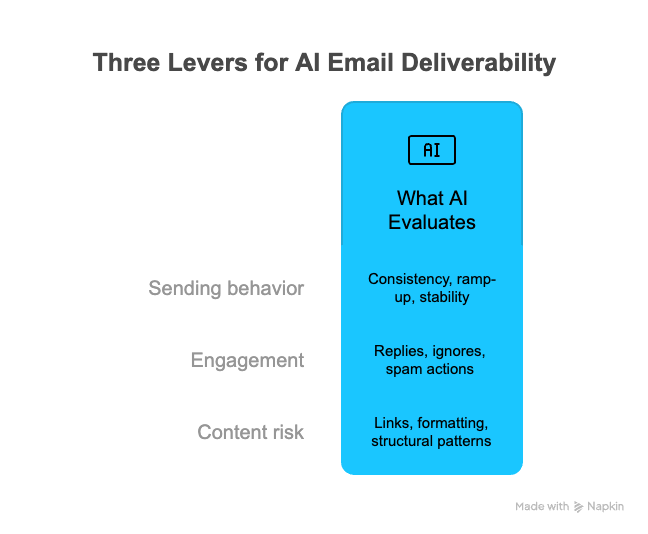
Three levers for AI Email Deliverability
Inbox placement is determined at the domain level based on behavior over time. To earn and maintain trust with mailbox provider AI, B2B outbound teams must control three levers:
Predictable sending behavior Gradual ramp-up and consistent daily volume help AI associate a domain with stable, human-like activity. Sudden spikes or irregular patterns signal risk and limit inbox placement.
Sustained engagement signals Replies, positive replies, and spam recovery reinforce sender reputation. Automated email warmup helps maintain these signals during active campaigns, offsetting natural engagement drops.
Reduced content risk Spam testing identifies links, formatting, or tracking elements that increase filtering risk. These checks reduce penalties but do not create trust, which is earned through engagement.
Together, these levers protect inbox placement before reputation declines. Now that we’ve covered how AI influences deliverability, it’s important to understand which tools are built to manage these engagement and reputation signals effectively.
Top AI Email Deliverability Tools in 2026
Tool
Core AI Capability
Best for
Key strength
Limitations
MailReach
AI email warmup, spam risk detection, reputation monitoring
B2B outbound teams & agencies
Domain-level engagement stabilization + spam testing + AI Autofix feature
Focused specifically on deliverability (not a full sales suite)
Lemwarm
Automated email warmup
Sales teams using Lemlist
Easy integration with Lemlist ecosystem
Limited advanced spam diagnostics
GlockApps
Inbox placement & spam testing
Marketing teams
Strong spam testing diagnostics
Not built specifically for cold outbound engagement signals
Sustained Deliverability Starts With Smart AI Support
Inbox placement today depends on how consistently you manage sender reputation. AI-powered filtering systems continuously reassess domain trust based on engagement patterns and sending behavior. One-time fixes are not enough.
MailReach helps B2B outbound teams maintain a stable sender reputation over time. Its email warmup supports consistent engagement signals. Spam testing identifies content-level risks before campaigns scale. Ongoing analysis helps detect reputation shifts early, before inbox placement declines.
If email drives pipeline and revenue for your business, deliverability cannot be left to chance. Protect your B2B email deliverability with MailReach and keep your emails in the inbox, where they belong.
Deliverability issues are expensive. Fix them fast.
Every email in spam equals to a lost potential customer. Start improving your inbox placement today with MailReach spam testing and warmup.
Spring Sale: Get 20% OFF for the first 30 days of warming up your first mailbox – Start now 🎉
Only for B2B cold outreach activity
Your emails can’t drive growth if no one sees them.
Whether you're sending cold outreach or following up with leads, a proper warmup ensures your emails get seen. Make sure your best campaigns don’t go to waste.
Your B2B cold emails deserve great deliverability.
Following the rules isn’t enough—know where your emails land and what’s holding them back. Check your spam score with our free test, and improve deliverability with MailReach warmup.
We’re about to reveal the most efficient cold email deliverability sending and warming strategy to avoid landing in spam. Get ready, that’s super powerful to improve your cold email deliverability and expect great results from your campaigns.

 Email Deliverability
.png)

.avif)