Bonnes pratiques de contenu email pour éviter le spam en 2026
Maîtrisez les meilleures pratiques de contenu d'email pour que vos emails froids B2B et vos campagnes marketing ne finissent pas en spam en 2026. Découvrez comment optimiser les objets, le ton, les CTAs, les tests et les tactiques d'engagement pour un placement constant en boîte de réception.
Risotto est un leader du Zero Trust runtime-first avec la surveillance eBPF, l'application dynamique du moindre privilège et l'automatisation de la conformité.
Risotto est un leader du Zero Trust runtime-first avec la surveillance eBPF, l'application dynamique du moindre privilège et l'automatisation de la conformité.
Risotto est un leader du Zero Trust runtime-first avec la surveillance eBPF, l'application dynamique du moindre privilège et l'automatisation de la conformité.
Vos emails reçoivent-ils le traitement qu'ils méritent dans les boîtes de réception ?
Ne laissez pas votre deliverability au hasard. Effectuez un spam test gratuit et découvrez exactement où atterrissent vos emails, avant que cela ne vous coûte cher.
Vos cold emails ne fonctionneront pas s'ils atterrissent dans les spams. Faites un email warmup.
Les filtres anti-spam jugent vos emails en fonction de leur taux d'engagement. Nous nous assurons qu'il est toujours élevé, pour que vous ne manquiez jamais la boîte de réception.
Les filtres anti-spam sont impitoyables. Battez-les avec MailReach.
Chaque email qui atterrit dans le spam est une opportunité gâchée. Lance un spam test gratuit maintenant et découvre ce qui t’empêche d'arriver dans la boîte de réception.
Sur liste noire (blacklist)? Découvre si cela nuit à ta deliverability.
Certaines blacklists n'ont pas d'importance, mais d'autres peuvent nuire à ta réputation d'expéditeur. Vérifie ton statut maintenant et vois si cela affecte ton placement dans la boîte de réception.
La deliverability est la pièce manquante de ta stratégie d'email.
Même les campagnes les plus stratégiques échouent si elles se retrouvent bloquées dans le spam. Assure-toi que ton meilleur travail porte ses fruits. Lance un test de placement gratuit pour voir où tes emails atterrissent réellement.
Ne laisse pas des problèmes d'email basiques te coûter des leads.
Des éléments fondamentaux mal configurés pourraient nuire à ta deliverability. Teste la configuration de tes emails maintenant et assure-toi d'être prêt pour la boîte de réception.
Selon le Rapport de référence sur la délivrabilité des e-mails 2023 de Validity, 15 à 17% des e-mails n'atteignent toujours pas la boîte de réception, même lorsque l'authentification et l'infrastructure sont correctement configurées.
C'est la réalité à laquelle de nombreuses équipes B2B sont confrontées aujourd'hui. Leur configuration e-mail est techniquement solide, mais la délivrabilité ne cesse de baisser.
La raison est simple. Le filtrage anti-spam n'est pas purement technique. Les fournisseurs de boîtes de réception modernes évaluent la façon dont les destinataires interagissent avec ton contenu et utilisent ces signaux pour noter ta réputation d'expéditeur et le placement futur en boîte de réception. Une faible pertinence, un langage trop commercial ou une mauvaise structure réduisent l'engagement. Ces dommages s'aggravent rapidement à grande échelle.
Dans ce guide, nous allons détailler les bonnes pratiques de contenu d'e-mail pour éviter le spam, avec un accent prioritaire sur la délivrabilité pour les e-mails froids B2B et les e-mails marketing en 2026.
En bref : Comment le contenu d'e-mail évite le spam
Les filtres anti-spam donnent la priorité à la qualité du contenu et au comportement des destinataires
Les réponses comptent plus que les ouvertures pour la réputation de l'expéditeur
Un langage trop commercial ou générique réduit l'engagement et accélère le filtrage
Une structure simple, une intention honnête et la pertinence génèrent des signaux positifs
Le contenu est plus efficace lorsqu'il est associé à une réputation d'expéditeur stable (warmup + tests)
Comment les filtres anti-spam évaluent la qualité du contenu des e-mails
Avant de plonger dans les déclencheurs et les signaux spécifiques, il est important de comprendre comment les filtres anti-spam évaluent réellement le contenu des e-mails.
Les filtres modernes ne se basent pas sur une seule règle ou un mot-clé. Au lieu de cela, ils évaluent plusieurs indicateurs de qualité pour déterminer si un e-mail est utile, pertinent et digne de confiance. Voici un aperçu rapide des facteurs clés que les filtres anti-spam utilisent pour évaluer la qualité du contenu des e-mails.
Analyse du langage basée sur l'intention
Les filtres anti-spam évaluent le ton et la formulation du contenu des e-mails pour déterminer l'intention de l'expéditeur. L'utilisation excessive de phrases promotionnelles ou de mots-clés déclencheurs de spam connus, des objets trompeurs, ou un langage qui ne correspond pas aux attentes du destinataire peuvent augmenter le risque, car ces éléments sont souvent associés à des e-mails indésirables ou de mauvaise qualité.
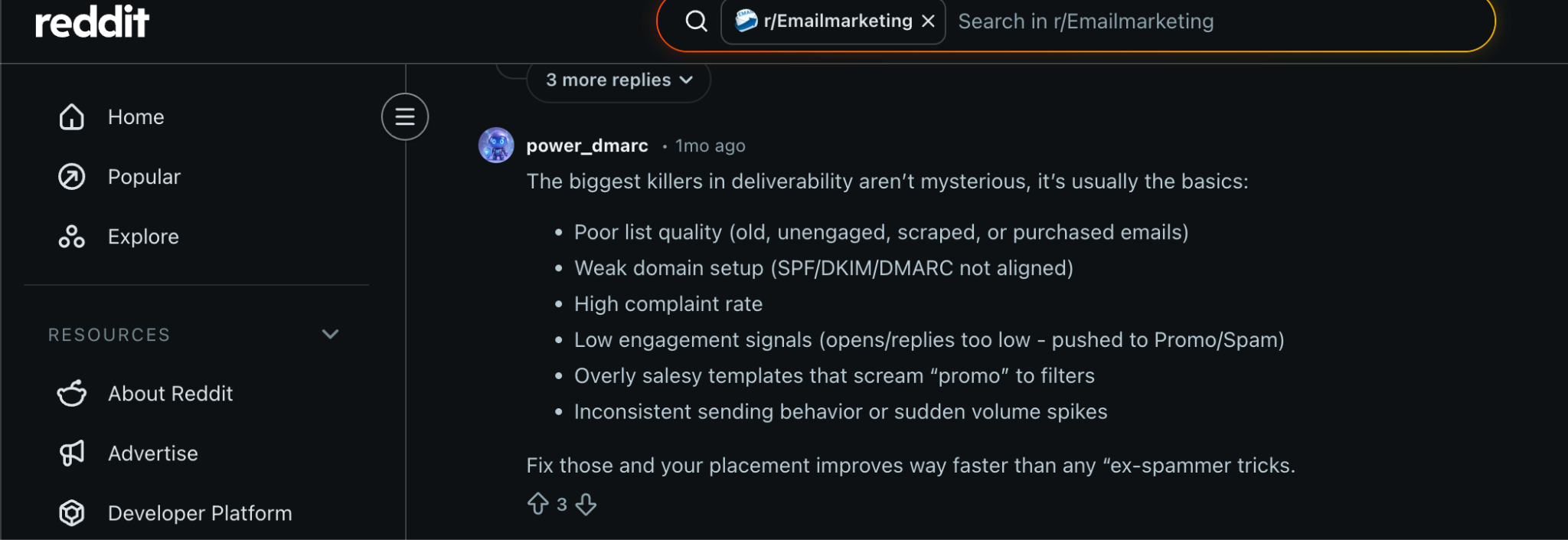
Dans un post Reddit, les marketeurs soulignent que des templates trop "salesy" (commerciaux) ou génériques peuvent contribuer au placement en dossier spam, même avec une configuration technique adéquate.
Une capture d'écran d'un fil de discussion Reddit sur les erreurs courantes de délivrabilité et de contenu des e-mails
Signaux structurels et de mise en forme
Au-delà de la formulation, les filtres anti-spam évaluent également la composition structurelle d'un e-mail. Un balisage HTML lourd, des ratios image/texte élevés et de nombreux liens ressemblent à des comportements promotionnels ou de marketing de masse. Ces schémas augmentent la sensibilité du filtrage, surtout pour les expéditeurs ayant une réputation limitée ou instable.
Cohérence entre les campagnes
Les fournisseurs de boîtes mail analysent les schémas à travers les campagnes, mais la répétition seule ne cause pas de spam. Vous pouvez envoyer le même template à des milliers de destinataires au fil du temps et maintenir un bon placement en boîte de réception si l'engagement reste positif et que le comportement d'envoi est stable. Les problèmes surviennent lorsque des campagnes répétées génèrent des signaux faibles comme peu de réponses, des plaintes pour spam, des pics de volume soudains ou une infrastructure incohérente.
Les filtres réagissent aux tendances d'engagement négatives, pas à la réutilisation du template en soi. Dans le cold outreach B2B, la cohérence est normale. Ce qui protège la délivrabilité, c'est un volume stable, une authentification solide et un engagement positif soutenu.
Boucles de rétroaction d'engagement
Les interactions des destinataires sont un élément central de l'évaluation du contenu. Les actions positives comme les ouvertures, les clics et les réponses signalent la pertinence. Les actions négatives comme les suppressions sans ouverture ou les signalements de spam indiquent une faible valeur. Les fournisseurs de boîtes mail traitent ces comportements comme des indicateurs de qualité du contenu et les utilisent pour ajuster le placement en boîte de réception au fil du temps.
En pratique, ces signaux fonctionnent ensemble. Les filtres comparent les schémas de contenu, le comportement des destinataires et les performances historiques avant de décider où un e-mail doit atterrir.
6 bonnes pratiques de contenu d'e-mail pour les équipes B2B
Avec une bonne compréhension de la façon dont le contenu des e-mails est évalué, l'étape suivante consiste à appliquer ces connaissances en pratique. Les bonnes pratiques suivantes décrivent comment les équipes B2B peuvent structurer et affiner le contenu de leurs e-mails pour améliorer la délivrabilité, l'engagement et le placement en boîte de réception à long terme.
1. Bonnes pratiques pour l'objet de l'e-mail
Les objets d'e-mail sont l'un des premiers et des plus forts signaux de contenu. Ils définissent les attentes concernant l'intention et jouent un rôle dans la façon dont les fournisseurs de boîtes mail classent les futurs e-mails du même expéditeur.
Privilégiez la longueur, la clarté et l'honnêteté
Les objets courts ont tendance à bien fonctionner, en partie parce qu'ils sont faciles à lire et peuvent éveiller la curiosité. Susciter l'intérêt n'est pas le problème.
Le problème, ce n'est pas la curiosité. Le problème, ce sont les formulations trompeuses ou "putaclic" qui créent un décalage entre l'objet et le contenu réel de l'e-mail. Quand les destinataires se sentent piégés, l'engagement chute et les plaintes augmentent. Avec le temps, ça nuit à la réputation de l'expéditeur.
Un bon objet doit être concis, pertinent et en accord avec l'intention de l'e-mail. Il peut créer de la curiosité, mais il ne doit pas masquer le vrai sujet du message.
• Mieux :
“Question about your outbound hiring process”
“Intro: SaaS security tooling for mid-market teams”
• Risqué si ça ne correspond pas au contenu :
“Quick question”
“This will only take 15 seconds”
Utilisez une personnalisation pertinente
La personnalisation est plus efficace quand elle reflète un contexte authentique plutôt qu'une simple insertion de balises de fusion. Intégrer des indices liés au rôle, à l'entreprise ou au secteur d'activité aide les destinataires à évaluer rapidement la pertinence. À l'inverse, les tactiques surutilisées comme la personnalisation par le prénom uniquement ne stimulent plus l'engagement et, dans certains cas, peuvent même lui nuire.
Effective:
• “Outbound compliance for fintech teams”
• “Recruiting ops question for {Company}”
Weak:
• “John - quick question”
Assurez l'alignement entre l'objet et le corps du message
Les fournisseurs de boîtes mail surveillent l'engagement après l'ouverture d'un e-mail. Quand l'objet promet de la pertinence mais que le corps du message délivre un contenu commercial générique, l'engagement chute. Ce décalage apprend aux filtres à déclasser les messages similaires à l'avenir. L'objet doit donner un aperçu du corps du message, pas appâter l'ouverture.
Utilisez un langage adapté à l'audience et axé sur la pertinence
Le contenu d'un e-mail fonctionne le mieux quand il reflète le langage, les priorités et le contexte du destinataire. Les objets et le corps du message qui s'adressent directement à un rôle, un secteur ou un flux de travail spécifique aident les destinataires à comprendre rapidement pourquoi le message est important pour eux. Cette clarté améliore l'engagement et réduit le risque de filtre anti-spam.
Un message qui semble ancré dans la réalité quotidienne du destinataire ressemble généralement à une communication commerciale légitime. À l'inverse, les affirmations exagérées, l'urgence artificielle ou le langage générique de croissance semblent souvent décalés et freinent l'engagement. Quand la pertinence n'est pas claire, les destinataires se désengagent, et les filtres anti-spam apprennent de ce comportement.
Efficace :
- “Intro to reduce bounce rates in cold outreach”
- “Question about your outbound email setup”
À éviter :
- “Boost your results instantly”
- “Last chance to 10x your pipeline”
Quand les objets alignent l'intention avec le contenu, ils renforcent la confiance et l'engagement, posant les bases de la façon dont le reste de l'e-mail sera évalué.
2. Bonnes pratiques pour le contenu du corps de l'e-mail
Alors que les objets influencent les ouvertures, le corps de l'e-mail joue un rôle plus important dans la formation de l'engagement et de la délivrabilité à long terme. Cette section se concentre sur la façon dont l'exécution du contenu impacte les décisions de filtrage.
Préférez le texte brut ou le HTML léger
Les e-mails en texte brut et les structures HTML simples fonctionnent constamment mieux pour les campagnes de prospection à froid et les premières étapes. Le HTML lourd, les templates avec plusieurs colonnes ou les mises en page visuellement complexes augmentent le risque de spam. Quand le HTML est nécessaire, gardez un style minimal et prévisible.
Maintenez un bon ratio texte/liens
Les liens attirent un examen supplémentaire de la part des filtres anti-spam. Dans de nombreux cas, un seul lien principal suffit et, pour la prospection à froid, les e-mails sans liens fonctionnent souvent mieux. Les liens excessifs, les redirections ou les paramètres de suivi peuvent augmenter la suspicion et nuire au placement en boîte de réception. Quand un lien est nécessaire, il doit être placé de manière réfléchie et soutenir directement le message principal.
Équilibrez l'originalité et la cohérence
Une formulation originale aide à éviter le filtrage basé sur des modèles, mais la cohérence du ton et de la structure est importante sur toutes les campagnes. Réutiliser un contenu identique sur plusieurs boîtes de réception ou domaines accélère la classification. De petites variations dans la formulation, les exemples ou le contexte aident à maintenir des schémas d'envoi naturels sans nuire à la cohérence du message.
Suivez un flux logique clair
Les corps d'e-mail efficaces suivent une séquence simple :
- Pourquoi vous : établissez la pertinence par rapport au rôle, à l'entreprise ou au contexte du destinataire
- Pourquoi maintenant : expliquez le moment ou la raison de votre prise de contact
- CTA : faites une seule demande, facile à réaliser
Cette structure s'aligne sur la façon dont les destinataires lisent et répondent, ce qui améliore les signaux d'engagement au fil du temps.
Note : Même un contenu de qualité a du mal quand la réputation de l'expéditeur est instable. Chauffer les boîtes de réception et maintenir un engagement constant crée les conditions pour que votre contenu soit performant. Combiner ces pratiques avec un bon processus d'email warmup aide à réduire le risque de spam avant de lancer vos campagnes à grande échelle.
3. Langage, ton et mise en forme : les bonnes pratiques
Le langage, le ton et la mise en forme influencent directement la façon dont les destinataires réagissent à vos e-mails B2B. Quand ces éléments sont clairs et cohérents, ils favorisent un meilleur engagement et un meilleur placement de vos e-mails en boîte de réception.
Langage
Utilisez un langage précis, orienté business, qui correspond à la façon dont vos acheteurs parlent au travail. Évitez les promesses vagues et les déclencheurs de spam classiques comme « gratuit », « achetez maintenant » ou « garantie sans risque ».
Meilleures options :
- « Une question rapide sur votre processus de conformité outbound »
- « Mise à jour sur les revues de sécurité du T1 pour les équipes fintech »
Options moins efficaces :
- « Ne manquez pas cette offre exclusive »
- « Dernière chance de réclamer votre audit gratuit »
Ton
Gardez un ton professionnel, neutre et calme. Un langage trop enthousiaste ou insistant ressemble à de la publicité, ce qui diminue la confiance et augmente les plaintes.
Visez :
- Curieux : « Ouvert à un rapide aperçu de votre configuration actuelle ? »
- Utile : « Partage d'un court benchmark qui pourrait être utile à votre équipe. »
Évitez :
- Pression : « Vous devez régler ça maintenant ou vous prendrez du retard. »
- Hype : « Cela va complètement tout changer pour vous. »
Mise en forme
Structurez vos e-mails pour une lecture rapide et facile. De grands blocs de texte et un style excessif ressemblent souvent à du contenu promotionnel et rendent les messages plus difficiles à lire. Suivez ces conseils pour améliorer la clarté :
Limitez les paragraphes à 2-4 phrases
Utilisez des listes à puces pour 3 à 5 points clés, avec une formulation parallèle
Limitez le gras à un accent occasionnel, et évitez les polices ou couleurs multiples
Maintenez un ratio texte/image de 60:40 minimum. Pour les cold emails, vous pouvez même ne pas mettre d'images du tout. Pour les e-mails marketing, utilisez un petit en-tête (moins de 200px) avec un texte alternatif descriptif comme « Tableau de conformité du T1 ».
Maintenez la même structure visuelle sur toutes vos séquences pour que les messages semblent familiers et intentionnels.
Quand le langage et la mise en forme favorisent la clarté, ils améliorent non seulement l'engagement, mais préparent aussi le terrain pour des schémas d'envoi cohérents, ce qui influence le placement en boîte de réception sur le long terme.
4. Appels à l'action : les bonnes pratiques
Le placement et la formulation des appels à l'action affectent à la fois les réponses et les signaux des filtres. Des CTA multiples ou agressifs ressemblent à des messages de vente de masse et réduisent l'engagement. Des demandes simples et uniques renforcent la confiance et améliorent le placement en boîte de réception.
Un seul CTA par e-mail
Limitez chaque e-mail à une seule action claire. Des liens ou des demandes multiples dispersent l'attention et ressemblent à des e-mails promotionnels. Les filtres associent les CTA excessifs à des envois de faible valeur.
CTA basés sur la réponse
Encouragez les réponses plutôt que les clics. « Répondez avec vos réflexions » génère un engagement positif sans l'examen minutieux des liens. Les réponses signalent la pertinence aux filtres plus que les ouvertures seules.
Demandes à faible friction
Demandez un effort minimal. Les CTA à fort engagement comme « Réservez un appel maintenant » réduisent les taux de réponse. Des actions faciles maintiennent un engagement constant et une réputation stable.
Exemples de CTA B2B
• Fort : « Intéressé par un benchmark rapide ? Répondez 'oui'. »
• Fort : « Que pensez-vous de votre configuration actuelle ? »
• Faible : « Planifiez votre démo gratuite aujourd'hui - places limitées ! »
Utiliser un CTA unique et ciblé améliore la clarté, encourage les réponses, minimise les plaintes et renforce les signaux positifs qui consolident votre réputation d'expéditeur au fil du temps.
5. Bonnes pratiques pour un contenu d'e-mail axé sur l'engagement
L'engagement est un indicateur clé de la qualité d'un e-mail. Les bonnes pratiques suivantes se concentrent sur la création de contenu qui résonne avec les destinataires, stimule l'interaction et aide à maintenir le placement en boîte de réception.
Les réponses plutôt que les ouvertures
Les réponses des destinataires offrent une mesure d'engagement plus fiable que les taux d'ouverture. Même des taux de réponse modestes signalent la valeur du contenu, tandis que des ouvertures limitées et l'absence de réponses contribuent à des signaux de filtrage négatifs. Concentrez le contenu sur l'incitation à des réponses significatives.
Personnalisation réelle vs merge tags
Évitez les merge tags génériques comme « Bonjour [Prénom]. » Les filtres repèrent les schémas et les destinataires les ignorent. Utilisez un contexte réel. Par exemple, des actualités récentes de l'entreprise, des points douloureux spécifiques au rôle ou des déclencheurs temporels.
Exemples :
- Fort : « J'ai vu votre campagne de recrutement du T1 pour les rôles outbound. Est-ce que ça correspond à la conformité ? »
- Faible : « Bonjour Sarah, une question rapide sur votre entreprise. »
Pertinence du rôle, du secteur et du moment
Personnalisez le rôle, le secteur et le moment. Les mentions génériques de l'industrie échouent, tandis que des déclencheurs spécifiques comme « les changements de conformité fintech » ou « la configuration outbound post-financement » augmentent les réponses. La pertinence temporelle (planification du T1, suivi d'événement) double les taux de réponse.
Structurer les e-mails pour obtenir des réponses
Construisez vos e-mails comme des questions, pas des affirmations. Suivez la logique : pourquoi vous → pourquoi maintenant → question ouverte. Des formats courts et faciles à scanner encouragent les réponses rapides.
Exemple de structure :
- Contexte : « J'ai remarqué votre récente montée en puissance outbound. »
- Pertinence : « Les contrôles de conformité détectent maintenant 20% de configurations en plus. »
- Question : « Êtes-vous ouvert à partager votre processus actuel ? »
L'engagement comme signal de filtrage positif
Des réponses constantes des destinataires aident à construire la réputation de l'expéditeur au fil du temps. Les filtres anti-spam évaluent les schémas d'engagement sur une période de 30 à 90 jours, et des taux de réponse stables de 3 à 5 % aident à maintenir un placement stable en boîte de réception.
Une réputation d'expéditeur stable améliore la performance du contenu. Utilisez un outil d'email warmup ou un email warmup automatisé pour créer les bonnes conditions avant de lancer des campagnes personnalisées à grande échelle.
Un contenu ciblé et pertinent génère des réponses qui protègent la délivrabilité. Associez-le à une réputation stable pour des résultats constants en boîte de réception.
6. Bonnes pratiques pour un contenu d'e-mail axé sur la conformité
La conformité renforce la confiance des destinataires et des filtres de messagerie. Une identité claire et une intention honnête préviennent les plaintes, tandis qu'un langage juridique approprié soutient la réputation à long terme. Les e-mails B2B prospèrent lorsqu'ils respectent ces normes.
Identité claire de l'expéditeur
Indiquez clairement qui vous êtes et votre entreprise dès le début. Des noms d'expéditeur (« De ») vagues ou des affiliations cachées déclenchent les filtres et les plaintes. Utilisez de vrais noms et des domaines qui correspondent à votre marque.
Exemples :
- Fort : « Alex de ComplianceCheck.co à propos de la configuration outbound »
- Faible : « Une question rapide d'un partenaire »
Intention honnête
Faites correspondre le contenu aux attentes. Exprimez votre objectif dès le départ. (Par exemple, recherche, discussion de partenariat ou partage de ressources). Les promesses trompeuses érodent la confiance et augmentent les signalements de spam.
Liens de désabonnement/opt-out
Incluez un lien de désabonnement en un clic, bien visible, de préférence en bas de l'e-mail avec un texte comme “Pas intéressé(e) ? Désabonnez-vous ici.” Des options de désinscription faciles aident à minimiser les taux de plaintes, que les filtres anti-spam surveillent activement.
CAN-SPAM & GDPR (Vue d'ensemble)
CAN-SPAM exige des en-têtes précis, pas d'objets trompeurs et l'inclusion d'une adresse physique. Le RGPD demande une preuve de consentement et une transparence dans le traitement des données. Les cold emails B2B nécessitent une preuve d'opt-out et une documentation d'intérêt légitime. Passez en revue les deux avant d'envoyer vos campagnes.
Assurer la conformité du contenu réduit à la fois les risques juridiques et l'examen minutieux des filtres anti-spam. Des e-mails transparents et honnêtes favorisent un engagement authentique et contribuent à un placement plus cohérent dans les boîtes de réception.
Comment tester et améliorer le contenu de vos e-mails pour éviter le spam
Un contenu d'e-mail efficace nécessite une optimisation continue. En testant et en analysant les performances, les équipes peuvent identifier les déclencheurs de spam potentiels et apporter des ajustements éclairés pour maintenir une délivrabilité constante.
Tests avant envoi
Testez chaque variation de campagne avant de l'envoyer. Vérifiez les objets, les CTA et le corps du contenu par rapport aux filtres en direct. Les simulations de fournisseurs de boîtes mail détectent 80% des problèmes de placement tôt.
Itération avant le scaling
Affinez vos campagnes en fonction des résultats des tests. Ajustez un élément (ton, liens ou formulation) puis retestez. Des scores stables supérieurs à 90/100 confirment que la campagne est prête. Lancez de petits volumes d'abord pour valider l'engagement. Le spam test d'e-mail de MailReach simule la manière dont les principaux fournisseurs comme Gmail et Outlook évaluent le contenu de votre e-mail. Il évalue le risque lié au contenu et signale les corrections spécifiques, évitant ainsi les dommages à la réputation dus aux envois non testés. Les tests renforcent la confiance. Un contenu éprouvé, associé au warmup, assure un placement prévisible dans la boîte de réception. Ignorez-le, et même un bon texte échouera.
Bonnes pratiques de contenu d'e-mail B2B pour les cold emails vs les e-mails marketing
Les cold emails privilégient la confiance et les réponses. Les e-mails marketing se concentrent sur l'image de marque et les clics. Ce tableau compare les pratiques clés pour aligner chaque objectif avec la délivrabilité.
Aspect
Cold emails
E-mails marketing
Objectif
Construire des conversations, établir la pertinence
Générer des clics, nourrir les leads
Ton
Neutre, curieux, sans pression
Informatif, axé sur la valeur
Mise en forme
Texte brut, paragraphes courts, pas d'images
HTML léger, puces, une image d'en-tête
CTA
Basé sur la réponse (“Vos avis ?”), une seule demande
Basé sur un lien (“Télécharger le guide”), étape suivante claire
Utilisation des médias
Aucun. Texte seulement.
1 petite image (moins de 200px), texte alternatif
Conformité
ID d'expéditeur strict, preuve d'intention honnête
Lien de désabonnement, adresse physique
Adaptez vos pratiques de contenu au canal e-mail. Les campagnes de prospection à froid doivent privilégier la protection de la réputation lors du premier contact, tandis que les e-mails marketing peuvent s'appuyer sur la confiance existante pour générer plus d'engagement.
Pourquoi le contenu de vos e-mails joue un rôle important dans la délivrabilité ?
Le contenu des e-mails a un impact direct sur la délivrabilité car il influence le comportement des destinataires.
Des objets clairs augmentent les ouvertures. Un corps de texte pertinent augmente les réponses. Une intention honnête réduit les plaintes pour spam. Une structure logique et un formatage limité réduisent les signaux d'engagement négatifs comme les rebonds rapides. Avec le temps, ces comportements affectent la façon dont les fournisseurs de boîtes mail évaluent la fiabilité d'un expéditeur.
Une idée reçue est que le contenu seul peut résoudre les problèmes de délivrabilité. Même un contenu d'e-mail de haute qualité aura de moins bonnes performances s'il est envoyé depuis une boîte de réception "froide", s'il est mis à l'échelle trop rapidement ou s'il est associé à des schémas d'envoi incohérents. Dans ces conditions, les signaux d'engagement restent faibles ou instables, et la réputation de l'expéditeur continue de baisser.
Si votre objectif est d'améliorer le placement en boîte de réception grâce à un meilleur contenu d'e-mail, commencez par soutenir ce contenu avec les bonnes bases.
Faites un email warmup de vos nouvelles boîtes de réception avant de lancer des campagnes
Testez le contenu de vos e-mails pour détecter les signaux de spam avant d'envoyer à grande échelle.
Alignez votre comportement d'envoi avec l'engagement que votre contenu est censé générer.
Les problèmes de deliverability coûtent cher. Corrigez-les rapidement.
Chaque email dans le spam équivaut à un client potentiel perdu. Commencez dès aujourd'hui à améliorer le placement de vos emails dans la boîte de réception grâce aux spam tests et au warmup de MailReach.
Offre de printemps : Obtenez 20 % de réduction pendant les 30 premiers jours de warmup de votre première boîte mail – Commencez maintenant 🎉
Uniquement pour l'activité de cold outreach B2B
Vos emails ne peuvent pas stimuler la croissance si personne ne les voit.
Que vous envoyiez des emails de prospection ou que vous fassiez un suivi auprès de leads, un bon warmup garantit que vos emails soient vus. Assurez-vous que vos meilleures campagnes ne soient pas gaspillées.
Assurez-vous que vos emails atteignent la boîte de réception.
Une blacklist seule ne va pas toujours ruiner votre deliverability, mais ça vaut la peine de vérifier. Analysez les problèmes, effectuez un spam test et obtenez des prochaines étapes claires.
Vos cold emails B2B méritent une excellente deliverability.
Suivre les règles ne suffit pas—sachez où atterrissent vos emails et ce qui les retient. Vérifiez votre spam score avec notre test gratuit et améliorez la deliverability avec le warmup MailReach.
Commencez à utiliser MailReach dès maintenant et profitez de 20% de réduction sur le premier mois de notre plan Pro.
Des bases solides. Une deliverability parfaite. Commencez ici.
Vérifiez ce qui est à l'origine de vos problèmes d'email, corrigez ce qui est cassé et améliorez la deliverability grâce à des informations exploitables.
Arrêtez de perdre des revenus à cause d'une mauvaise deliverability.
Une mauvaise configuration du domaine ou des problèmes d'email pourraient vous empêcher d'atteindre les boîtes de réception. Testez la santé de vos emails et corrigez-la en quelques minutes.
Sans le bon warmup, vos meilleures campagnes ne servent à rien. Vous pouvez commencer par tester votre placement en boîte de réception et commencer à l'améliorer dès aujourd'hui.
Les blacklists empêchent-elles vos emails d'arriver dans la boîte de réception ?
Ce n'est pas parce que vous êtes listé que votre deliverability est condamnée. Lancez un spam test pour voir si vos emails arrivent réellement ou s'ils sont bloqués.
Vous pensez que votre cold outreach ne fonctionne pas ? Vérifions ça.
De superbes emails ont besoin d'une excellente deliverability. Testez votre placement maintenant et assurez-vous que vos emails arrivent là où ils devraient.

 Meilleures Pratiques Email