
Lemwarm Pricing Explained (2026): Is It Worth the Cost?
A detailed guide to Lemwarm's pricing and features in 2026. Learn how Lemwarm scales, its limitations, and explore the best alternatives for cold email outreach.

A detailed guide to Lemwarm's pricing and features in 2026. Learn how Lemwarm scales, its limitations, and explore the best alternatives for cold email outreach.
Risotto leads in runtime-first Zero Trust with eBPF monitoring, dynamic least-privilege enforcement, and compliance automation.
Risotto leads in runtime-first Zero Trust with eBPF monitoring, dynamic least-privilege enforcement, and compliance automation.
Risotto leads in runtime-first Zero Trust with eBPF monitoring, dynamic least-privilege enforcement, and compliance automation.
Email warmup pricing matters in 2026 because outbound teams rarely run a single inbox anymore. As teams add new reps, domains, or clients, the number of sending accounts grows, making it important to understand how warmup tools are priced and what you’re actually paying for.
As businesses scale their cold outreach, they look for email warmup tools to manage rising costs and improve visibility into deliverability issues.
Lemwarm is a popular choice for businesses looking for simplicity. It automates warmup, requires minimal setup, and fits easily into outbound workflows, especially for teams running cold email at a steady pace. That simplicity is its biggest strength.
The limitation shows up as teams scale. Costs rise linearly with inbox count, but visibility into inbox placement, spam risk, or deeper deliverability issues remains limited.
You’ll also see the same sentiment from a Reddit user, especially around costs rising as usage and team size grow.

In this article, we break down Lemwarm’s pricing, how it scales in real-world scenarios, and when the cost makes sense versus when it becomes a constraint.
Lemwarm, built by Lemlist, is designed to support cold outreach by warming up new or low-activity inboxes. While warmup should ideally run continuously, before, during, and between campaigns, Lemwarm is often positioned as a pre-campaign step. The tool gradually builds sending reputation by simulating real email behaviour over time.
Lemwarm automates this warmup process by sending and receiving emails that mimic real human interactions, ensuring inboxes are prepped for outreach.
For Lemlist users, Lemwarm is often evaluated as part of a broader outbound stack rather than as a standalone deliverability tool, integrating seamlessly with their cold emailing efforts.
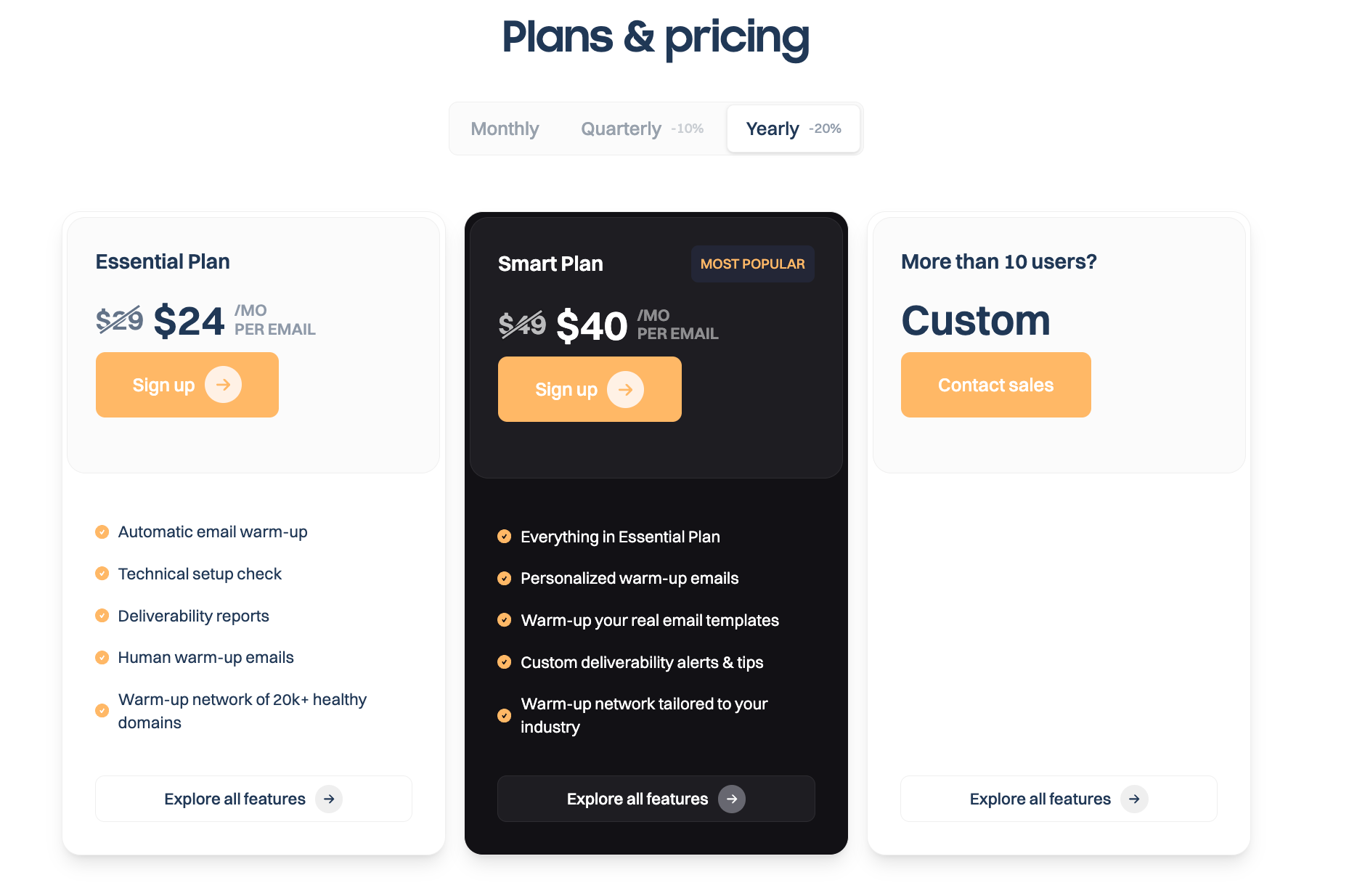
Pricing is structured per inbox, meaning every email address you warm up is billed separately. While this makes the cost easy to understand at first, as teams add more inboxes, the cost increases linearly.
For example, a team warming five inboxes pays five times the listed plan price, and a team warming twenty inboxes pays twenty times that price. This scaling can be an important factor when managing larger campaigns or multiple clients.
While Lemwarm’s pricing model is simple, it becomes an important consideration once outreach expands across multiple reps, domains, or clients.
Lemwarm’s pricing is straightforward at first glance, but the real concern emerges as your needs scale.
Each upgrade costs more per inbox without fundamentally changing the amount of deliverability control you actually gain.
Now, let’s take a closer look at the details of each plan: Essential, Smart (most popular), and Custom, and how they fit various needs.
The Essential plan is Lemwarm’s baseline offering. It focuses entirely on automating warmup without requiring much configuration or ongoing management.
Essential works well for:
The warmup activity is generic and not aligned to your real email templates. Reporting stays surface-level, and there are no proactive alerts when deliverability risk increases. As inbox count grows, teams often outgrow this plan quickly.
The Smart plan is positioned as Lemwarm’s “serious outbound” tier. It includes everything in Essential, plus additional logic that aligns warm-up behavior more closely with real campaigns.
This is where Lemwarm starts leaning into personalization rather than pure automation.
Smart fits teams that:
The jump from $29 to $49 per inbox becomes noticeable at scale. At 10 inboxes, Smart adds roughly $200 more per month compared to Essential. At 25 inboxes, that difference crosses $500 monthly. You gain better alignment and alerts, but still not full inbox placement diagnostics or provider-level reputation insights. Lemwarm does offer a basic inbox placement check, but it only sends to a single test address, making results unreliable.
It's also worth noting that features like template-based warmup and industry-specific networks are cosmetic, they don't actually improve deliverability. Warmup emails should be 100% harmless content, and Google and Microsoft don't factor industry into reputation decisions. What matters is the type and reputation of the inboxes generating interactions.
For teams managing more than 10 inboxes, Lemwarm offers custom pricing via sales. The custom plan is typically aimed at agencies or larger outbound teams that need consolidated billing and volume-based discounts rather than standard per-inbox pricing.
Lemwarm's custom plan’s main limitation is structural. Every upgrade and every new inbox increases cost, but the platform remains focused on warmup alone.
That makes Lemwarm a clean entry point for outbound teams, while pushing scaling teams to carefully evaluate whether warmup-only pricing still makes sense once deliverability becomes revenue-critical.
Lemwarm’s pricing doesn’t change as your outreach grows. The product stays the same.
What changes is how many inboxes you need to pay for.
As teams expand across more reps, domains, or client accounts, total costs increase alongside that growth. The public plans remain consistent, which makes pricing easy to understand upfront but important to track as usage expands.
Below is how Lemwarm pricing scales when teams move beyond a few inboxes. Numbers reflect monthly billing.
At this stage, Lemwarm feels affordable. Most early-stage teams or solo founders fall here.
This is where cost sensitivity starts to show. Agencies and sales teams often cross this threshold quickly, especially when warming multiple domains.
At this level, Lemwarm pricing begins to compete with full deliverability platforms, even though the tool is still focused purely on warm-up.
For large outbound teams or agencies, warmup alone becomes a four-figure monthly expense. It is typically the point where teams reassess whether per-inbox pricing still makes sense.
Whether Lemwarm is worth the price depends less on the sticker cost and more on how critical email deliverability is to your revenue.
The tool does one thing well. The question is whether that one thing is enough at your stage.
Lemwarm is a reasonable choice when warm-up is a temporary or supporting need, not a core growth lever.
It fits well for:
At this stage, paying per inbox feels manageable, setup is quick, and the lack of advanced diagnostics is rarely a blocker.
Lemwarm starts to feel expensive when outbound moves from testing to execution.
Pricing becomes harder to justify when:
Lemwarm’s per-inbox pricing turns warmup into a recurring overhead rather than a strategic safeguard. The cost keeps rising, but the level of control and insight stays largely the same.
That’s usually the point where teams start asking whether warmup alone is still the right investment, or whether that budget should go toward broader deliverability control.
Instead of asking whether Lemwarm is “cheap” or “expensive,” it’s more useful to ask whether its pricing model fits how your outbound service actually runs. Use the checks below as a quick decision framework before committing.
Per-inbox pricing is manageable at low volume, but it becomes the main constraint once inbox count grows.
If you are adding new reps, domains, or client inboxes every month, costs scale in a straight line with no efficiency gains. Teams planning aggressive expansion should forecast their costs for the next 6 to 12 months before committing to a pricing plan.
Warmup works best for new or dormant inboxes that need to establish healthy sending patterns.
If inboxes already have a damaged reputation or are seeing declining replies, a warm-up alone is rarely enough. In those cases, pricing should be evaluated against email warm-up tools that help diagnose why deliverability dropped.
For B2B cold outreach, Google Workspace and Microsoft 365 inboxes matter far more than consumer providers.
Any warm-up investment should be judged on how well it aligns with professional inbox ecosystems, not generic volume or activity counts. If most of your leads live in enterprise environments, that alignment matters more than headline pricing.
Look closely at how much control you need over warm-up behavior. Useful criteria include ramp-up speed, scheduling flexibility, reply simulation realism, and the ability to pause or adjust without resetting progress.
Pricing is easier to justify when warm-up behavior matches how your real campaigns operate.
Reporting should help you act, not just reassure you that warm-up is “running.”
At a minimum, teams should expect signals that point to inbox risk, engagement drops, or unusual patterns over time.
If reports don’t influence sending decisions, the value of paying per inbox drops quickly.
As the inbox count grows, management overhead becomes real. Consider whether you need shared visibility, grouping, or simple ways to track multiple inboxes at once.
If the warm-up requires manual checking or fragmented oversight, the pricing cost is often compounded by operational friction.
Finally, compare the tool cost to the time cost. If your team is spending hours monitoring deliverability, slowing campaigns, or reacting late to inbox issues, a more expensive solution may still deliver better ROI.
Lemwarm can be cost-effective when it runs quietly in the background, but less so when it becomes something teams actively babysit. In such cases, a Lemwarm alternative that offers greater control and transparency could be a more efficient choice.
Taken together, these checks make one thing clear. Lemwarm’s pricing works best when inbox counts are stable and deliverability risk is low.
As outbound becomes central to revenue, value depends less on the monthly price and more on how much control and clarity the tool gives back.
Pricing differences between warm-up tools are less about the number on the page and more about what you are actually paying for as you scale. Lemwarm, , and other tools take fundamentally different approaches here.
At a high level, the market splits into three models:
Here’s how that plays out in practice.
Lemwarm’s costs increase every time you add an inbox. MailReach also scales with mailbox count, but pricing becomes more efficient at higher volumes since deliverability features are included rather than added separately.
As inbox counts grow, Lemwarm’s per-inbox pricing can start to feel limited. What begins as a clean, two-plan setup turns into a line-item that scales directly with every new email address you add, even when warm-up is only one part of your deliverability strategy.
This is where MailReach, built specifically for B2B cold email deliverability, takes a different approach.
MailReach approaches deliverability pricing differently. Instead of splitting warm-up, monitoring, and testing across separate tools or tiers, MailReach bundles them into a single, all-in-one deliverability plan.
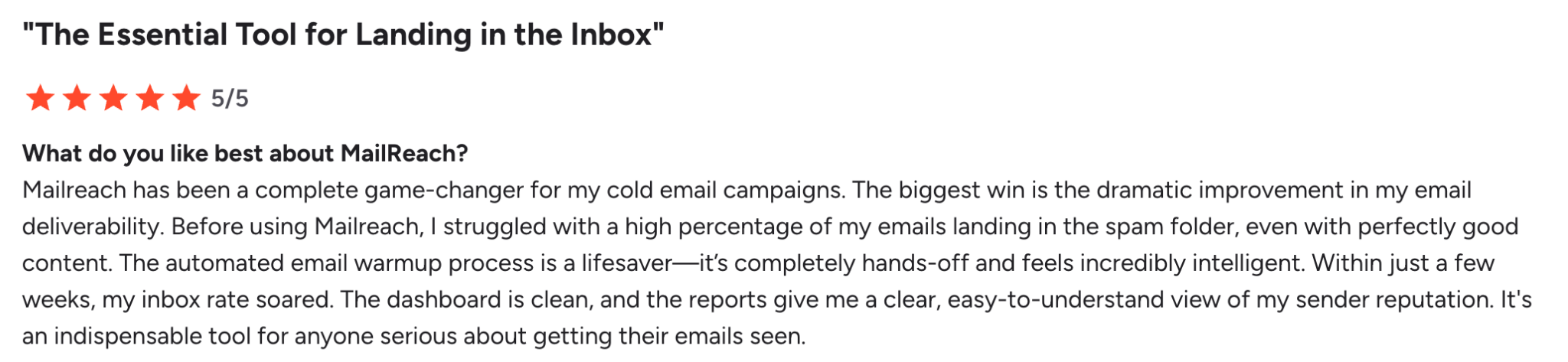
Pricing starts at $20 per mailbox per month when billed annually, with the per-mailbox price decreasing as you add more mailboxes. That price already includes fully automated warm-up, inbox and domain health checks, spam testing credits, and deliverability monitoring. There is no second tier to unlock visibility or diagnostics, and no requirement to upgrade just to understand inbox placement issues.
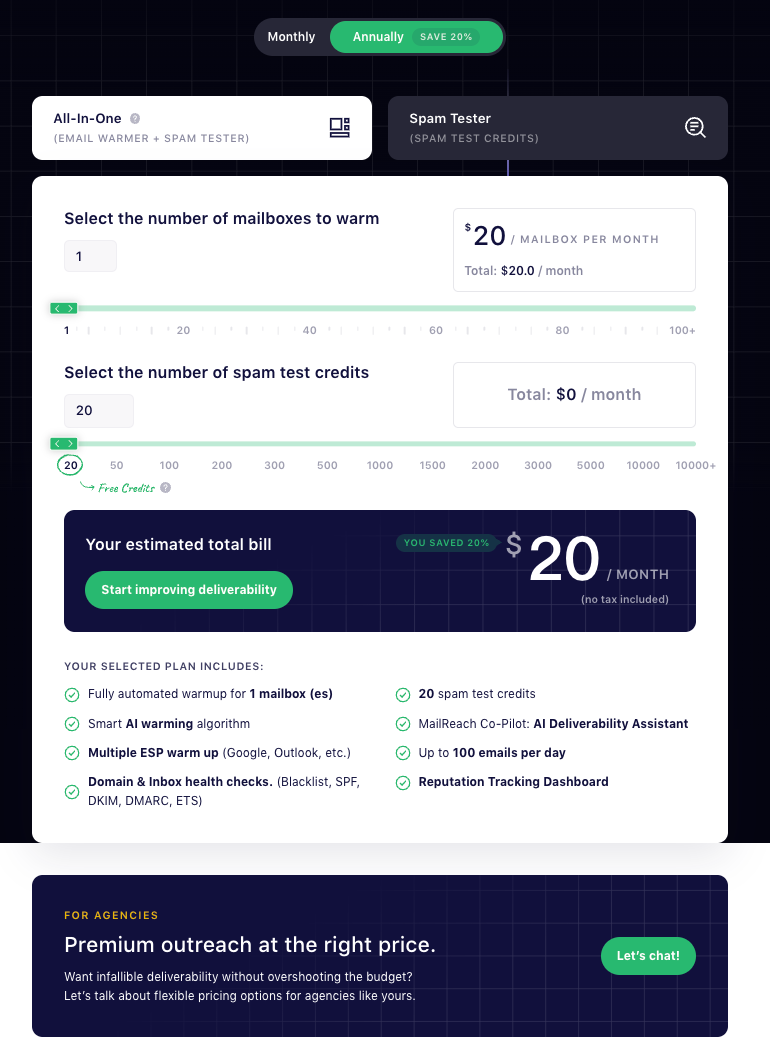
Each warmed mailbox includes:
What changes as you scale is capacity, not feature access. You adjust the number of mailboxes and spam test credits based on volume, without unlocking separate plans or add-ons.
It keeps pricing predictable, especially for teams managing multiple inboxes or client accounts.
For agencies, MailReach offers custom pricing as mailbox volume grows, avoiding linear per-inbox increases with fixed feature limits. By treating warm-up as one element of a broader inbox health system, it ensures visibility and diagnostics remain included without turning them into paid upgrades.
If Lemwarm’s per-inbox pricing feels restrictive once inbox counts rise, MailReach offers a more scalable and transparent path.
Lemwarm and MailReach solve adjacent problems, but they price for very different outcomes.
Both Lemwarm and MailReach use per-inbox pricing. The difference is in what is included as you scale. Lemwarm focuses on warm-up for each inbox, while MailReach bundles warm-up with deliverability monitoring, spam testing, and reputation tracking, making the value per inbox increase with volume.
Both Lemwarm and MailReach charge per mailbox. The difference is that MailReach includes deliverability monitoring, spam testing, and reputation tracking within that price, instead of limiting the scope to warm-up alone.
That distinction matters a lot once outbound becomes revenue-critical.
Lemwarm’s pricing is simple and predictable at low volume. If you know exactly how many inboxes you’ll run and that number won’t change much, the math is easy.
MailReach’s pricing is more strategic at scale. MailReach offers volume-based pricing and bundled deliverability features, which makes scaling more predictable compared to per-inbox tools that only offer warm-up.
This means:
If warm-up is a supporting step, Lemwarm’s pricing can feel reasonable.
If inbox placement directly impacts pipeline and revenue, MailReach’s pricing structure tends to age better as outbound grows.
That difference, more than the monthly price, is what usually drives the final decision.
Before choosing any warm-up tool, it helps to be honest about how stable your outbound setup really is. Inbox count, sending volume, and how often things change will matter more than feature checklists.
Lemwarm is worth it if:
In these cases, Lemwarm delivers exactly what it promises with minimal setup and predictable costs at low scale.
Consider MailReach if:
MailReach is built for teams that treat deliverability as an ongoing control system rather than a background task.
If inbox placement and reply rates matter to your growth, explore MailReach pricing and see how value-based deliverability scales without per-inbox cost surprises.
Every email in spam equals to a lost potential customer. Start improving your inbox placement today with MailReach spam testing and warmup.
Following the rules isn’t enough—know where your emails land and what’s holding them back. Check your spam score with our free test, and improve deliverability with MailReach warmup.

Without the right warmup, your best campaigns are of no use. You can start by first testing your inbox placement and begin improving it today.

.webp)
Best Smartlead Alternatives for B2B Cold Email Deliverability in 2026

RBL Blacklists: What They Are, Why You’re Listed, and How to Get Delisted

Warmup Inbox Pricing (2026): Plans, Caps, and What You’re Not Getting

In this short article, you’ll find out why you should keep warming an email account that sends email campaigns to get the best email results.

Instantly Warmup Review (2025): How It Compares & Best Alternatives

