Mejores Prácticas de Contenido de Email para No Caer en Spam en 2026
Domina las mejores prácticas de contenido de email para que tus emails fríos B2B y campañas de marketing no acaben en spam en 2026. Aprende sobre líneas de asunto, tono, CTAs, pruebas y tácticas de engagement para que tus emails siempre lleguen a la bandeja de entrada.
Risotto lidera en Zero Trust con un enfoque 'runtime-first', monitoreo eBPF, aplicación dinámica de privilegios mínimos y automatización de cumplimiento.
Risotto lidera en Zero Trust con un enfoque 'runtime-first', monitoreo eBPF, aplicación dinámica de privilegios mínimos y automatización de cumplimiento.
Risotto lidera en Zero Trust con un enfoque 'runtime-first', monitoreo eBPF, aplicación dinámica de privilegios mínimos y automatización de cumplimiento.
¿Tus correos llegan a la bandeja de entrada como deberían?
No dejes la entregabilidad de tus emails al azar. Haz una prueba de spam gratuita y descubre exactamente dónde están aterrizando tus correos, antes de que te cueste caro.
Tus emails fríos no funcionarán si caen en spam. Caliéntalos.
Los filtros de spam juzgan tus correos según su tasa de engagement. Nos aseguramos de que siempre sea alta, para que nunca te pierdas la bandeja de entrada.
¿En lista negra? Descubre si está afectando tu entregabilidad.
Algunas listas negras no importan, pero otras pueden dañar la reputación de tu remitente. Verifica tu estado ahora y mira si está afectando la llegada a tu bandeja de entrada.
La entregabilidad es la pieza que falta en tu estrategia de email.
Incluso las campañas más estratégicas fallan si terminan en spam. Asegúrate de que tu mejor trabajo obtenga resultados. Haz una prueba de ubicación gratuita para ver a dónde están llegando realmente tus emails.
No dejes que problemas básicos de email te cuesten clientes potenciales.
Una configuración básica incorrecta podría estar afectando tu entregabilidad. Prueba tu configuración de email ahora y asegúrate de que estás listo para la bandeja de entrada.
Según el Informe de Referencia de Entregabilidad de Email de Validity de 2023, entre el 15 y el 17% de los emails aún no llegan a la bandeja de entrada, incluso cuando la autenticación y la infraestructura están configuradas correctamente.
Esta es la realidad que muchos equipos B2B enfrentan hoy. Su configuración de email es técnicamente correcta, pero la entregabilidad sigue disminuyendo.
La razón es sencilla. El filtrado de spam no es puramente técnico. Los proveedores de buzones modernos evalúan cómo interactúan los destinatarios con tu contenido y usan esas señales para calificar la reputación del remitente y la futura ubicación en la bandeja de entrada. Una relevancia baja, un lenguaje demasiado comercial o una estructura deficiente reducen la interacción. Este daño se agrava rápidamente a escala.
En esta guía, desglosaremos las mejores prácticas de contenido de email para evitar el spam, con un enfoque prioritario en la entregabilidad para emails fríos B2B y emails de marketing en 2026.
TL;DR: Cómo el contenido del email evita el spam
Los filtros de spam priorizan la calidad del contenido y el comportamiento del destinatario
Las respuestas importan más que las aperturas para la reputación del remitente
Un lenguaje demasiado comercial o genérico suprime la interacción y acelera el filtrado
Una estructura simple, una intención honesta y la relevancia generan señales positivas
El contenido funciona mejor cuando se combina con una reputación de remitente estable (email warmup + pruebas)
Cómo los filtros de spam evalúan la calidad del contenido del email
Antes de adentrarnos en los activadores y señales específicos, es clave entender cómo los filtros de spam evalúan realmente el contenido de los correos.
Los filtros modernos no se basan en una sola regla o palabra clave, sino que evalúan múltiples indicadores de calidad para determinar si un correo es útil, relevante y confiable. Aquí te dejamos un resumen rápido de los factores clave que los filtros de spam usan al revisar la calidad del contenido de un correo.
Análisis de lenguaje basado en la intención
Los filtros de spam evalúan el tono y la redacción del contenido del correo para determinar la intención del remitente. El uso excesivo de frases promocionales o de palabras que activan el spam conocidas, asuntos engañosos o un lenguaje que no se alinea con las expectativas del destinatario puede aumentar el riesgo, ya que estos elementos suelen asociarse con correos no deseados o de baja calidad.
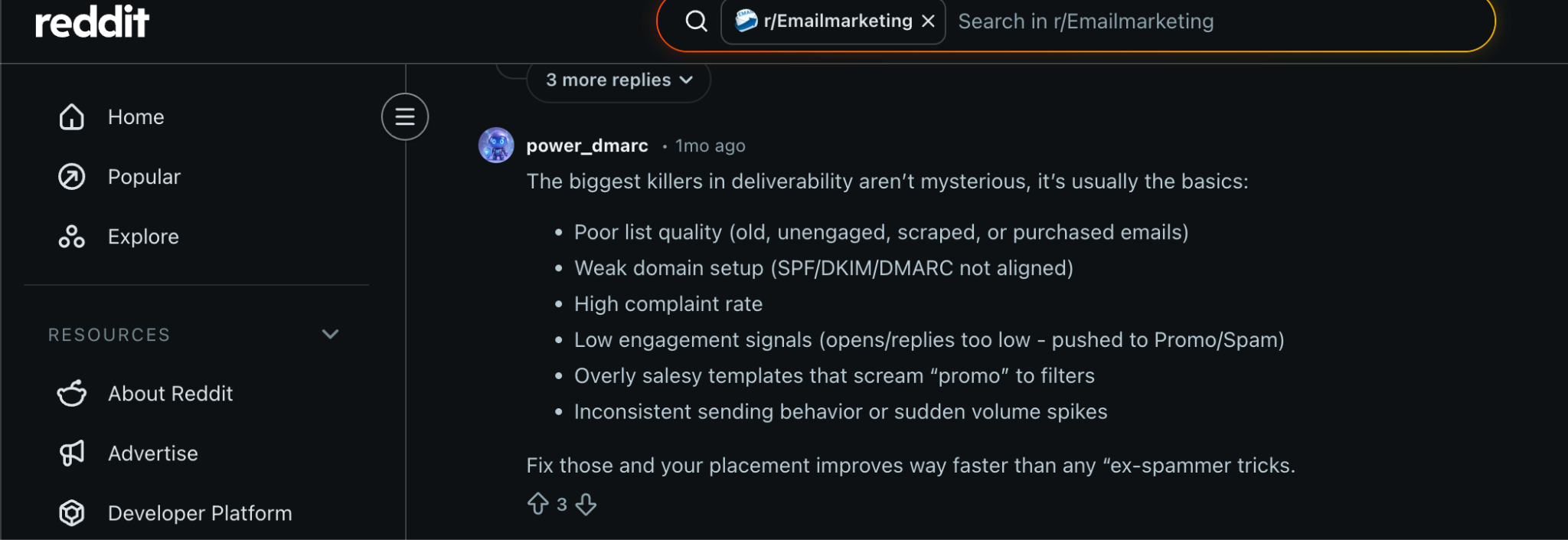
En una publicación de Reddit, los especialistas en marketing destacan que las plantillas demasiado 'vendedoras' o genéricas pueden contribuir a que los correos terminen en la carpeta de spam, incluso con una configuración técnica adecuada.
Una captura de pantalla de un hilo de Reddit sobre errores comunes en la entregabilidad y el contenido de los correos
Señales estructurales y de formato
Más allá de la redacción, los filtros de spam también evalúan la composición estructural de un correo. Un marcado HTML pesado, altas proporciones de imagen a texto y múltiples enlaces se asemejan a un comportamiento promocional o de marketing masivo. Estos patrones aumentan la sensibilidad del filtrado, especialmente para remitentes con una reputación limitada o inestable.
Consistencia entre campañas
Los proveedores de buzones de correo analizan patrones entre campañas, pero la repetición por sí sola no causa spam. Puedes enviar la misma plantilla a miles de destinatarios a lo largo del tiempo y mantener una buena ubicación en la bandeja de entrada si el engagement se mantiene positivo y el comportamiento de envío es estable. Los problemas surgen cuando las campañas repetidas generan señales débiles, como pocas respuestas, quejas de spam, picos repentinos de volumen o una infraestructura inconsistente.
Los filtros reaccionan a las tendencias negativas de engagement, no a la reutilización de plantillas en sí. En la prospección en frío B2B, la consistencia es normal. Lo que protege la entregabilidad es un volumen constante, una autenticación sólida y un engagement positivo sostenido.
Bucles de retroalimentación de engagement
Las interacciones de los destinatarios son una parte fundamental de la evaluación del contenido. Acciones positivas como aperturas, clics y respuestas indican relevancia. Acciones negativas como eliminaciones sin abrir o informes de spam indican bajo valor. Los proveedores de buzones de correo tratan estos comportamientos como indicadores de la calidad del contenido y los usan para ajustar la ubicación en la bandeja de entrada con el tiempo.
En la práctica, estas señales funcionan en conjunto. Los filtros comparan patrones de contenido, el comportamiento del destinatario y el rendimiento histórico antes de decidir dónde debe aterrizar un correo.
6 mejores prácticas de contenido de correo electrónico para equipos B2B
Con una comprensión de cómo se evalúa el contenido de los correos, el siguiente paso es aplicar esos conocimientos en la práctica. Las siguientes mejores prácticas describen cómo los equipos B2B pueden estructurar y refinar el contenido de los correos para mejorar la entregabilidad, el engagement y la ubicación a largo plazo en la bandeja de entrada.
1. Mejores prácticas para el asunto del correo electrónico
Los asuntos de los correos sirven como una de las señales de contenido más tempranas y fuertes. Establecen expectativas sobre la intención y juegan un papel en cómo los proveedores de buzones de correo clasifican futuros correos del mismo remitente.
Prioriza la longitud, la claridad y la honestidad
Los asuntos cortos suelen funcionar bien, en parte porque son fáciles de escanear y pueden despertar la curiosidad. Generar interés no es un problema.
El problema no es la curiosidad. El problema es la redacción engañosa o de 'clickbait' que crea una desconexión entre el asunto y el contenido real del correo. Cuando los destinatarios se sienten engañados, el engagement disminuye y las quejas aumentan. Con el tiempo, eso daña la reputación del remitente.
Un asunto potente debe ser conciso, relevante y alineado con la intención del correo. Puede generar curiosidad, pero no debe ocultar de qué trata realmente el mensaje.
• Mejor:
“Pregunta sobre tu proceso de contratación externa”
“Intro: Herramientas de seguridad SaaS para equipos de mercado medio”
• Arriesgado si no se alinea con el contenido:
“Pregunta rápida”
“Esto solo te tomará 15 segundos”
Usa una personalización relevante
La personalización es más efectiva cuando refleja un contexto genuino en lugar de una inserción de merge-tags superficial. Incorporar señales específicas de rol, empresa o industria ayuda a los destinatarios a evaluar rápidamente la relevancia. En contraste, tácticas sobreutilizadas como la personalización solo con el nombre ya no impulsan el engagement y, en algunos casos, pueden incluso dañarlo.
Effective:
• “Outbound compliance for fintech teams”
• “Recruiting ops question for {Company}”
Weak:
• “John - quick question”
Asegúrate de que el asunto y el cuerpo del email coincidan
Los proveedores de correo monitorean la interacción después de que se abre un email. Si el asunto promete algo relevante pero el cuerpo es un texto de ventas genérico, la interacción baja. Esa falta de coincidencia entrena a los filtros para que clasifiquen mensajes similares como menos importantes en el futuro. El asunto debería ser un adelanto del cuerpo, no un anzuelo para que lo abran.
Usa un lenguaje que se alinee con tu audiencia y que priorice la relevancia
El contenido de un email funciona mejor cuando refleja el lenguaje, las prioridades y el contexto del destinatario. Los asuntos y el cuerpo del mensaje que hablan directamente a un rol, industria o flujo de trabajo específico, ayudan a los destinatarios a entender rápidamente por qué el mensaje es importante para ellos. Esta claridad mejora la interacción y reduce el riesgo de ser marcado como spam.
Los mensajes que se sienten conectados con la realidad diaria del destinatario suelen parecerse a una comunicación de negocios legítima. Por el contrario, las afirmaciones exageradas, la urgencia artificial o el lenguaje genérico de crecimiento a menudo se sienten fuera de lugar y disminuyen la interacción. Cuando la relevancia no es clara, los destinatarios se desconectan y los filtros de spam aprenden de ese comportamiento.
Efectivo:
- “Introducción para reducir las tasas de rebote en el cold outreach”
- “Pregunta sobre tu configuración de email saliente”
Evita:
- “Impulsa tus resultados al instante”
- “Última oportunidad para multiplicar por 10 tu pipeline”
Cuando los asuntos de los emails alinean la intención con el contenido, fortalecen la confianza y la interacción, sentando las bases de cómo se evaluará el resto del email.
2. Mejores prácticas para el contenido del cuerpo del email
Aunque los asuntos influyen en las aperturas, el cuerpo del email juega un papel más importante en la interacción y la entregabilidad a largo plazo. Esta sección se enfoca en cómo la ejecución del contenido afecta las decisiones de filtrado.
Prefiere texto plano o HTML ligero
Los emails de texto plano y las estructuras HTML simples funcionan consistentemente mejor para el cold outreach y las etapas iniciales de contacto. El HTML pesado, las plantillas con varias columnas o los diseños visualmente complejos aumentan el riesgo de spam. Cuando el HTML es necesario, mantén el estilo mínimo y predecible.
Mantén una buena proporción de texto a enlaces
Los enlaces atraen un escrutinio adicional de los filtros de spam. En muchos casos, un solo enlace principal es suficiente y, en el cold outreach, los emails sin enlaces a menudo funcionan mejor. Demasiados enlaces, redirecciones o parámetros de seguimiento pueden aumentar la sospecha y afectar la llegada a la bandeja de entrada. Cuando un enlace es necesario, debe colocarse de forma cuidadosa y apoyar directamente el mensaje principal.
Equilibra la originalidad con la consistencia
La redacción original ayuda a evitar el filtrado basado en patrones, pero la consistencia en el tono y la estructura es importante en todas las campañas. Reutilizar el mismo texto en diferentes bandejas de entrada o dominios acelera la clasificación. Pequeñas variaciones en la forma de expresarse, los ejemplos o el contexto ayudan a mantener patrones de envío naturales sin romper la coherencia del mensaje.
Sigue un flujo lógico claro
Los cuerpos de email efectivos siguen una secuencia simple:
- Por qué tú: establece la relevancia para el rol, la empresa o el contexto del destinatario
- Por qué ahora: explica el momento o la razón para contactar
- CTA: haz una única solicitud de baja fricción
Esta estructura se alinea con la forma en que los destinatarios leen y responden, lo que mejora las señales de interacción con el tiempo.
Nota: Incluso el contenido más sólido tiene problemas cuando la reputación del remitente es inestable. Calentar las bandejas de entrada y mantener una interacción constante crea las condiciones para que el contenido funcione de manera consistente. Combinar estas prácticas con un proceso adecuado de
email warmup ayuda a reducir el riesgo de spam antes de escalar tus envíos.
3. Mejores prácticas de lenguaje, tono y formato
El lenguaje, el tono y el formato influyen directamente en cómo responden los destinatarios a los emails B2B. Cuando estos elementos son claros y consistentes, favorecen una mayor interacción y una mejor llegada a la bandeja de entrada.
Lenguaje
Usa un lenguaje preciso y enfocado en los negocios que coincida con la forma en que tus compradores hablan en el trabajo. Evita promesas vagas y los clásicos disparadores de spam como “gratis”, “compra ahora” o “garantía sin riesgo”.
Opciones más fuertes:
- “Pregunta rápida sobre tu proceso de cumplimiento saliente”
- “Actualización sobre las revisiones de seguridad del Q1 para equipos fintech”
Opciones más débiles:
- “No te pierdas esta oferta exclusiva”
- “Última oportunidad para reclamar tu auditoría gratuita”
Tono
Mantén un tono profesional, neutral y tranquilo. Un lenguaje demasiado entusiasta o insistente suena a publicidad, lo que disminuye la confianza y aumenta las quejas.
Busca esto:
- Curioso: “¿Te gustaría echar un vistazo rápido a tu configuración actual?”
- Útil: “Compartiendo un pequeño benchmark que podría ser útil para tu equipo.”
Evita esto:
- Presión: “Necesitas arreglar esto ahora o te quedarás atrás.”
- Exageración: “Esto lo cambiará todo para ti.”
Formato
Estructura tus correos para que se puedan escanear de forma rápida y sin esfuerzo. Los bloques de texto grandes y el estilo excesivo suelen parecer contenido promocional y hacen que los mensajes sean más difíciles de leer. Sigue estas pautas para mejorar la claridad:
Mantén los párrafos de 2 a 4 frases
Usa viñetas para 3-5 puntos clave, con frases paralelas
Limita la negrita para énfasis ocasional, y evita múltiples fuentes o colores
Mantén una proporción de texto a imagen de 60:40 como mínimo. Para correos fríos, puedes omitir las imágenes por completo. Para correos de marketing, usa un encabezado pequeño (menos de 200px) con texto alternativo descriptivo como "Gráfico de cumplimiento del Q1".
Mantén la misma estructura visual en todas las secuencias para que los mensajes se sientan familiares e intencionados.
Cuando el lenguaje y el formato apoyan la claridad, no solo mejoran el engagement, sino que también preparan el terreno para patrones de envío consistentes, lo que influye en la ubicación a largo plazo en la bandeja de entrada.
4. Mejores prácticas para el Call-to-Action
La ubicación y el texto del call-to-action afectan tanto a las respuestas como a las señales de los filtros. Múltiples o agresivos CTAs se parecen a mensajes de ventas masivos y reducen el engagement. Peticiones simples y únicas generan confianza y mejoran la ubicación en la bandeja de entrada.
Un CTA por correo
Limita cada correo a una única acción clara. Múltiples enlaces o peticiones dispersan la atención y se parecen a correos promocionales. Los filtros asocian el exceso de CTAs con envíos de bajo valor.
CTAs basados en respuestas
Fomenta las respuestas en lugar de los clics. "Responde con tus ideas" genera un engagement positivo sin el escrutinio de enlaces. Las respuestas señalan relevancia a los filtros más que solo las aperturas.
Peticiones de bajo esfuerzo
Pide un esfuerzo mínimo. CTAs de alto compromiso como "Reserva una llamada ahora" reducen las tasas de respuesta. Acciones fáciles mantienen el engagement constante y la reputación estable.
Ejemplos de CTA B2B
• Fuertes: "¿Te interesa un benchmark rápido? Responde 'sí'."
• Fuertes: "¿Qué piensas de tu configuración actual?"
• Débiles: "¡Agenda tu demo gratis hoy - cupos limitados!"
Usar un CTA único y enfocado mejora la claridad, fomenta las respuestas, minimiza las quejas y refuerza las señales positivas que fortalecen tu reputación como remitente con el tiempo.
5. Mejores prácticas para el contenido de correo impulsado por el engagement
El engagement es un indicador clave de la calidad del correo. Las siguientes mejores prácticas se centran en crear contenido que resuene con los destinatarios, impulse la interacción y ayude a mantener la ubicación en la bandeja de entrada.
Respuestas sobre aperturas
Las respuestas de los destinatarios ofrecen una medida más fiable de engagement que las tasas de apertura. Incluso tasas de respuesta modestas señalan el valor del contenido, mientras que las aperturas limitadas y la ausencia de respuestas contribuyen a señales de filtrado negativas. Enfoca el contenido en provocar respuestas significativas.
Personalización de verdad vs. merge tags
Olvídate de los merge tags genéricos como "Hola [Nombre]". Los filtros detectan patrones y los destinatarios los ignoran. Usa un contexto de verdad. Por ejemplo, noticias recientes de la empresa, problemas específicos del rol o momentos clave.
Ejemplos:
- Fuerte: "Vi su impulso de contratación en el primer trimestre para roles de outbound. ¿Lo están combinando con el cumplimiento?"
- Débil: "Hola Sarah, una pregunta rápida sobre tu negocio."
Relevancia del rol, el sector y el momento justo
Personaliza el rol, el sector y el momento. Las menciones genéricas de la industria no funcionan, mientras que los disparadores específicos como "cambios en la normativa fintech" o "configuración de outbound post-financiación" disparan las respuestas. La relevancia temporal (planificación del primer trimestre, seguimiento de eventos) duplica las tasas de respuesta.
Cómo estructurar tus correos para que te respondan
Escribe correos como preguntas, no como afirmaciones. Sigue el esquema por qué tú → por qué ahora → pregunta abierta. Los formatos cortos y fáciles de leer animan a responder rápido.
Ejemplo de estructura:
- Contexto: "Vi que están escalando su outbound últimamente."
- Relevancia: "Las revisiones de cumplimiento ahora detectan un 20% más de configuraciones."
- Pregunta: "¿Te gustaría compartir tu proceso actual?"
El engagement como una señal positiva para los filtros
Las respuestas constantes de tus destinatarios ayudan a construir la reputación de tu remitente con el tiempo. Los filtros de spam evalúan los patrones de engagement durante un período de 30 a 90 días, y unas tasas de respuesta estables del 3 al 5% ayudan a mantener tus correos en la bandeja de entrada.
Una reputación de remitente estable mejora el rendimiento de tu contenido. Usa una herramienta de email warmup o email warmup automatizado para crear las condiciones adecuadas antes de escalar campañas personalizadas.
Un contenido enfocado y relevante genera respuestas que protegen tu entregabilidad. Combínalo con una reputación estable para conseguir resultados consistentes en la bandeja de entrada.
6. Mejores prácticas para el contenido de tus correos, centrado en el cumplimiento
El cumplimiento genera confianza con tus destinatarios y con los filtros de correo. Una identidad clara y una intención honesta evitan quejas, mientras que un lenguaje legal adecuado ayuda a tu reputación a largo plazo. Los correos B2B funcionan genial cuando siguen estos estándares.
Una identidad de remitente clara
Di quién eres y de qué empresa eres desde el principio. Nombres de "De" vagos o afiliaciones ocultas activan los filtros y las quejas. Usa nombres y dominios reales que coincidan con tu marca.
Ejemplos:
- Fuerte: "Alex de ComplianceCheck.co sobre la configuración de outbound"
- Débil: "Una pregunta rápida de un socio"
Intención clara y honesta
Ajusta el contenido a lo que esperan. Di tu objetivo desde el principio. (Por ejemplo, investigación, hablar de una colaboración o compartir recursos). Las promesas engañosas erosionan la confianza y aumentan los reportes de spam.
Enlaces para darte de baja / opt-out
Incluye un enlace de cancelación de suscripción de un solo clic que se vea bien, preferiblemente al final del correo con un texto como “¿No te interesa? Date de baja aquí.” Las opciones fáciles para darte de baja ayudan a minimizar las quejas, algo que los filtros de spam vigilan de cerca.
CAN-SPAM y GDPR (a grandes rasgos)
CAN-SPAM exige encabezados precisos, que no haya asuntos engañosos y que incluyas una dirección física. GDPR pide prueba de consentimiento y transparencia en el manejo de datos. Los correos fríos B2B necesitan prueba de que pueden darse de baja y documentación de interés legítimo. Revisa ambos antes de enviar tus campañas.
Asegurarte de que tu contenido cumple las normas reduce tanto el riesgo legal como el escrutinio de los filtros de spam. Los correos transparentes y honestos fomentan un engagement de verdad y ayudan a que lleguen más consistentemente a la bandeja de entrada.
Cómo probar y mejorar el contenido de tus correos para evitar el spam
El contenido efectivo de tus emails necesita optimización constante. Al probar y analizar el rendimiento, los equipos pueden identificar posibles activadores de spam y hacer ajustes informados para mantener una entregabilidad consistente.
Pruebas previas al envío
Prueba cada variación de tu campaña antes de enviarla. Revisa los asuntos, los CTAs y el cuerpo del contenido con filtros reales. Las simulaciones de los proveedores de buzones detectan el 80% de los problemas de ubicación a tiempo.
Iteración antes de escalar
Ajusta tus campañas basándote en los resultados de las pruebas. Modifica un elemento (el tono, los enlaces o la forma de expresarte) y luego vuelve a probar. Puntuaciones estables por encima de 90/100 confirman que tu campaña está lista. Lanza pequeños volúmenes primero para validar el engagement. El email spam test de MailReach simula cómo los principales proveedores como Gmail y Outlook evalúan el contenido de tus emails. Evalúa el riesgo del contenido y señala soluciones específicas, evitando daños a la reputación por envíos no probados. Probar te da confianza. Contenido probado, junto con el warmup, te asegura una ubicación predecible en la bandeja de entrada. Si te lo saltas, incluso un buen copy fallará.
Mejores prácticas de contenido de email B2B para Cold Emails vs Marketing Emails
Los cold emails priorizan la confianza y las respuestas. Los marketing emails se centran en el branding y los clics. Esta tabla compara las prácticas clave para alinear cada objetivo con la entregabilidad.
Aspecto
Cold emails
Marketing emails
Objetivo
Generar conversaciones, establecer relevancia
Generar clics, nutrir leads
Tono
Neutral, curioso, sin presión
Informativo, priorizando el valor
Formato
Texto plano, párrafos cortos, sin imágenes
HTML ligero, viñetas, una imagen de cabecera
CTA
Basado en respuestas ("¿Qué te parece?"), una sola petición
Basado en enlaces ("Descargar guía"), un siguiente paso claro
Uso de medios
Ninguno. Solo texto.
1 imagen pequeña (menos de 200px), texto alternativo
Cumplimiento
ID de remitente estricto, prueba de intención honesta
Enlace para darse de baja, dirección física
Alinea tus prácticas de contenido con el canal de email. Cuando hagas 'cold outreach', prioriza proteger tu reputación en el primer contacto, mientras que los emails de marketing pueden aprovechar la confianza ya existente para conseguir más interacción.
¿Por qué el contenido de tus emails es tan importante para la 'deliverability'?
El contenido de tus emails impacta directamente en la 'deliverability' porque influye en cómo se comportan los destinatarios.
Asuntos claros aumentan las aperturas. Un texto relevante consigue más respuestas. Una intención honesta reduce las quejas de spam. Una estructura lógica y un formato sencillo disminuyen las señales de interacción negativas, como los rebotes rápidos. Con el tiempo, estos comportamientos influyen en cómo los proveedores de correo evalúan la fiabilidad de un remitente.
Un error común es pensar que el contenido por sí solo puede solucionar los problemas de 'deliverability'. Incluso un contenido de email de alta calidad tendrá un rendimiento bajo si se envía desde una bandeja de entrada 'fría', se escala demasiado rápido o se combina con patrones de envío inconsistentes. En esas condiciones, las señales de interacción siguen siendo débiles o inestables, y la reputación del remitente continúa bajando.
Si tu objetivo es mejorar la llegada a la bandeja de entrada con un mejor contenido de email, empieza por darle a ese contenido la base adecuada.
Calienta las bandejas de entrada nuevas antes de lanzar campañas.
Prueba el contenido de tus emails en busca de señales de spam antes de enviar a gran escala.
Alinea tu comportamiento de envío con la interacción que tu contenido está diseñado para generar.
Los problemas de deliverability son caros. Soluciónalos rápido.
Cada correo en spam equivale a un cliente potencial perdido. Empieza a mejorar tu posicionamiento en la bandeja de entrada hoy mismo con las pruebas de spam y el warmup de MailReach.
Oferta de primavera: Consigue un 20% de DESCUENTO durante los primeros 30 días de warmup de tu primer buzón – Empieza ahora 🎉
Solo para actividades de cold outreach B2B
Tus emails no pueden impulsar el crecimiento si nadie los ve.
Ya sea que estés haciendo cold outreach o dando seguimiento a tus leads, un buen warmup asegura que tus emails sean vistos. Asegúrate de que tus mejores campañas no se desperdicien.
Asegúrate de que tus emails lleguen a la bandeja de entrada.
Una lista negra por sí sola no siempre arruinará tu entregabilidad, pero vale la pena revisarla. Busca problemas, haz una prueba de spam y obtén los siguientes pasos claros.
Tus cold emails B2B merecen una gran entregabilidad.
Seguir las reglas no es suficiente: descubre dónde aterrizan tus emails y qué los está frenando. Verifica tu puntuación de spam con nuestra prueba gratuita y mejora la entregabilidad con el warmup de MailReach.
Problemas con la configuración de tu dominio o de tus emails podrían estar impidiendo que tus correos lleguen a la bandeja de entrada. Revisa la salud de tu email y arréglalo en minutos.
¿Las blacklists están impidiendo que tus emails lleguen a la bandeja de entrada?
Que estés en una lista no significa que tu deliverability esté perdida. Haz un test de spam para ver si tus emails están llegando o si se están bloqueando.

 Mejores Prácticas de Email