Comment améliorer le placement en boîte de réception B2B grâce à la délivrabilité email par IA
Découvrez comment l'IA impacte la délivrabilité des emails en 2026 et comment l'email warmup, les spam tests et la gestion de la réputation améliorent le placement en boîte de réception B2B.
La délivrabilité e-mail par IA désigne la pratique qui consiste à maintenir le placement en boîte de réception auprès des fournisseurs de boîtes mail comme Google et Microsoft, qui utilisent des systèmes d'apprentissage automatique pour évaluer en continu le comportement de l'expéditeur, l'engagement et la réputation du domaine.
Contrairement aux méthodes de délivrabilité traditionnelles basées sur des règles, qui reposent sur des vérifications statiques, des audits ponctuels et des seuils fixes, le filtrage basé sur l'IA réévalue la confiance de l'expéditeur presque en temps réel, en fonction des modèles comportementaux et de l'interaction du destinataire.
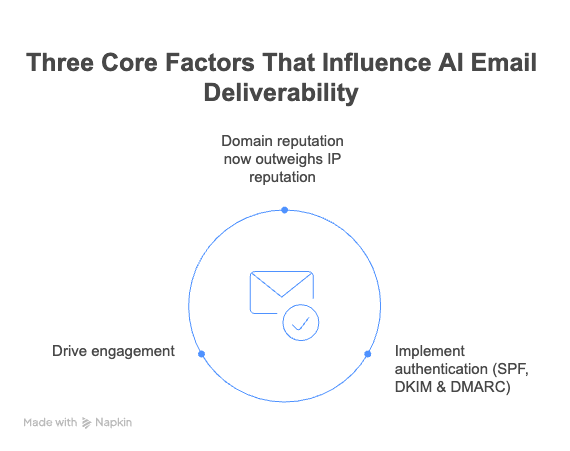
Trois facteurs clés façonnent la délivrabilité e-mail par IA : la réputation du domaine (qui l'emporte désormais sur la réputation IP), une authentification correcte via SPF, DKIM et DMARC (considérée comme un prérequis obligatoire, et non un facteur de différenciation), et les modèles d'engagement qui mettent à jour dynamiquement les scores de réputation de l'expéditeur.
Les systèmes de boîte de réception basés sur l'IA privilégient les signaux d'engagement forts plutôt que les taux d'ouverture, notamment les réponses, les réponses positives, les clics, les e-mails marqués comme importants et les conversations continues, car les protections de la vie privée et les ouvertures par proxy rendent les taux d'ouverture peu fiables.
Les signaux d'engagement négatifs — y compris les e-mails supprimés sans interaction, les messages ignorés, les e-mails laissés ou marqués comme spam, et les pics de volume suivis de baisses d'engagement — entraînent une baisse rapide des scores de réputation selon les modèles de filtrage par IA.
Le contenu influence indirectement la délivrabilité par le comportement qu'il génère ; les messages qui ne génèrent pas de réponses ou d'interactions affaiblissent la confiance du domaine au fil du temps, car les systèmes d'IA classent les modèles d'envoi en conséquence.
MailReach surveille les scores de réputation de l'expéditeur et les tendances d'engagement au fil du temps, et propose l'email warmup, des spam tests, la vérification des listes noires et des tests de placement en boîte de réception, avec une réduction promotionnelle de 20 % pour les 30 premiers jours d'email warmup d'une première boîte mail.
Risotto est un leader du Zero Trust runtime-first avec la surveillance eBPF, l'application dynamique du moindre privilège et l'automatisation de la conformité.
Risotto est un leader du Zero Trust runtime-first avec la surveillance eBPF, l'application dynamique du moindre privilège et l'automatisation de la conformité.
Risotto est un leader du Zero Trust runtime-first avec la surveillance eBPF, l'application dynamique du moindre privilège et l'automatisation de la conformité.
Vos emails reçoivent-ils le traitement qu'ils méritent dans les boîtes de réception ?
Ne laissez pas votre deliverability au hasard. Effectuez un spam test gratuit et découvrez exactement où atterrissent vos emails, avant que cela ne vous coûte cher.
Vos cold emails ne fonctionneront pas s'ils atterrissent dans les spams. Faites un email warmup.
Les filtres anti-spam jugent vos emails en fonction de leur taux d'engagement. Nous nous assurons qu'il est toujours élevé, pour que vous ne manquiez jamais la boîte de réception.
Les filtres anti-spam sont impitoyables. Battez-les avec MailReach.
Chaque email qui atterrit dans le spam est une opportunité gâchée. Lance un spam test gratuit maintenant et découvre ce qui t’empêche d'arriver dans la boîte de réception.
Sur liste noire (blacklist)? Découvre si cela nuit à ta deliverability.
Certaines blacklists n'ont pas d'importance, mais d'autres peuvent nuire à ta réputation d'expéditeur. Vérifie ton statut maintenant et vois si cela affecte ton placement dans la boîte de réception.
La deliverability est la pièce manquante de ta stratégie d'email.
Même les campagnes les plus stratégiques échouent si elles se retrouvent bloquées dans le spam. Assure-toi que ton meilleur travail porte ses fruits. Lance un test de placement gratuit pour voir où tes emails atterrissent réellement.
Ne laisse pas des problèmes d'email basiques te coûter des leads.
Des éléments fondamentaux mal configurés pourraient nuire à ta deliverability. Teste la configuration de tes emails maintenant et assure-toi d'être prêt pour la boîte de réception.
Le placement en boîte de réception est désormais l'un des plus grands freins à la croissance de l'outbound. Alors que les fournisseurs de boîtes mail s'appuient de plus en plus sur des outils de filtrage basés sur l'IA, les tactiques de délivrabilité manuelles et basées sur des règles perdent de leur efficacité.
Google et Microsoft utilisent des systèmes d'apprentissage automatique entraînés sur l'engagement, le comportement de l'expéditeur et les signaux de réputation pour décider du placement en boîte de réception. Ces systèmes sont plus rapides et plus stricts que jamais. De petits problèmes qui causaient autrefois un déclin progressif de la réputation peuvent maintenant déclencher un placement immédiat en spam.
Ce qui n'a pas changé, ce sont les fondamentaux. La réputation de l'expéditeur, le risque lié au contenu et la régularité d'envoi déterminent toujours la délivrabilité. L'IA ne fait qu'appliquer ces règles plus efficacement, en détectant les problèmes plus tôt et en appliquant les pénalités plus rapidement.
Dans cet article, nous expliquons comment l'IA influence la délivrabilité des e-mails, ce que les méthodes de délivrabilité modernes basées sur l'IA exigent, et comment les équipes outbound B2B peuvent s'adapter pour améliorer le placement en boîte de réception.
Qu'est-ce qui distingue la délivrabilité des e-mails par IA des méthodes traditionnelles ?
Les tactiques de délivrabilité traditionnelles étaient conçues pour un environnement de boîte de réception basé sur des règles, tandis que les fournisseurs de boîtes mail modernes fonctionnent différemment. Ils utilisent des modèles d'IA qui évaluent en continu le comportement de l'expéditeur et l'engagement du destinataire au fil du temps.
Les méthodes de délivrabilité traditionnelles reposent sur des vérifications statiques et des seuils fixes. Elles se concentrent sur l'évitement des déclencheurs de spam évidents et la validation de la configuration technique, comme l'authentification et les limites d'envoi. Ces pratiques sont toujours nécessaires, mais elles représentent la base plutôt que la logique que les fournisseurs de boîtes mail utilisent pour décider du placement en boîte de réception.
La délivrabilité des e-mails par IA, en revanche, est basée sur le comportement. Au lieu de demander si un e-mail passe une liste de contrôle, les modèles d'IA évaluent si un expéditeur gagne constamment la confiance des destinataires.
Critères
Méthodes de délivrabilité traditionnelles
Délivrabilité des e-mails basée sur l'IA
Modèle d'évaluation
Règles statiques et vérifications ponctuelles
Analyse continue du comportement
Revue du contenu
Évite les mots qui déclenchent le spam et les problèmes de formatage
Évalue comment les destinataires interagissent avec le message
Authentification.
Vérifie le SPF, le DKIM et le DMARC une seule fois
Réévalue la confiance en continu après l'authentification
Limites d'envoi
Plafonds quotidiens fixes
Apprend de la régularité des envois au fil du temps
Portée des données
Se base sur des données de campagne isolées
Analyse le comportement historique au niveau du domaine
Impact sur la réputation
Lent à refléter les dommages à la réputation
Ajuste les décisions de filtrage en temps quasi réel
Approche globale
Validation basée sur une checklist
Évaluation continue du score de confiance
Pourquoi les outils traditionnels échouent-ils face aux boîtes de réception pilotées par l'IA ?
Les anciens outils de délivrabilité ont été conçus pour des environnements statiques. Les boîtes de réception basées sur l'IA sont dynamiques. Ils échouent pour trois raisons principales :
1. Ils se basent sur des vérifications statiques. Les scans de mots spam, le nombre de liens et les tests d'authentification uniques ne prennent pas en compte le scoring basé sur l'engagement. Un domaine peut passer toutes les vérifications techniques et quand même atterrir en spam si l'interaction des destinataires diminue.
2. Ils fonctionnent par instantanés. Les audits ponctuels ne détectent pas la dérive progressive de la réputation causée par de petites baisses d'engagement, des schémas d'envoi incohérents ou des pics de volume. Les modèles de filtrage IA réévaluent la confiance en continu.
3. Ils réagissent trop lentement. Les révisions manuelles et les tests périodiques ne peuvent pas suivre le rythme des boucles de feedback de l'IA qui ajustent le placement en boîte de réception dès que des schémas de comportement apparaissent.
Les fournisseurs de boîtes mail se soucient moins de la façon dont un e-mail est construit et plus de la façon dont les destinataires y répondent. La délivrabilité des e-mails par l'IA privilégie des signaux tels que :
Taux de réponse et de réponse positive
E-mails retirés du spam
Cohérence du comportement d'envoi au fil du temps
Tendances d'engagement au niveau du domaine
Les règles statiques ne peuvent pas s'adapter à ces dynamiques, contrairement aux systèmes d'IA. C'est pourquoi une surveillance continue et la gestion de l'engagement sont désormais essentielles pour maintenir le placement en boîte de réception.
3 facteurs clés qui influencent la délivrabilité des e-mails par IA
Le filtrage des boîtes de réception basé sur l'IA repose sur les mêmes fondamentaux qui ont toujours défini la délivrabilité. Ce qui a changé, c'est la vitesse et la rigueur de l'application. Les fournisseurs de boîtes mail réévaluent désormais continuellement la confiance au niveau du domaine en combinant les signaux techniques avec les données d'engagement.
Facteurs qui influencent la délivrabilité des e-mails par IA
1. La réputation du domaine dépasse désormais la réputation de l'IP
Dans les boîtes de réception modernes, la réputation du domaine est le principal signal de confiance. La réputation de l'IP compte toujours dans certains scénarios à fort volume, mais le filtrage basé sur l'IA se concentre sur la façon dont un domaine se comporte au fil du temps.
Les fournisseurs de boîtes mail évaluent :
Tendances d'engagement liées au domaine d'envoi
Cohérence de l'activité d'envoi
Plaintes pour spam historiques et interactions négatives
C'est pourquoi faire tourner les IP ou compter sur une infrastructure propre ne fonctionne plus. Les systèmes d'IA corrèlent le comportement à travers les campagnes et les domaines. Si l'engagement est faible ou incohérent, le placement en boîte de réception en pâtit, quelle que soit la qualité de l'IP.
2. SPF, DKIM et DMARC sont obligatoires, pas des éléments différenciateurs
Les fournisseurs de boîtes mail s'attendent à ce que les expéditeurs légitimes aient :
Des enregistrements SPF qui autorisent les sources d'envoi
Des signatures DKIM qui valident l'intégrité des messages
Un alignement DMARC qui empêche l'usurpation d'identité
Sans une authentification correcte, la confiance est immédiatement dégradée ou la livraison est bloquée. Avec elle, les expéditeurs sont simplement éligibles pour être évalués sur l'engagement et le comportement.
L'IA ne récompense pas une authentification parfaite. Elle pénalise les mauvaises configurations. Une fois l'authentification correctement configurée, elle passe au second plan, et les signaux de réputation prennent le dessus.
3. Les modèles d'engagement façonnent directement les scores de réputation
Les systèmes d'IA mettent à jour en continu les scores de réputation des expéditeurs en fonction du comportement des destinataires. La réputation est dynamique, pas statique.
Lorsque les modèles d'engagement défavorables deviennent constants, les scores de réputation diminuent et les décisions de filtrage s'ajustent rapidement. Le placement en boîte de réception suit la réputation.
Des plateformes comme MailReach surveillent les tendances de réputation au fil du temps en utilisant des scores de réputation, aidant les équipes B2B outbound à détecter tôt les changements d'engagement et à stabiliser la confiance du domaine avant que le placement en boîte de réception ne chute.
Les domaines mal configurés ou nouvellement lancés intensifient ces signaux. Les modèles d'IA privilégient la protection des utilisateurs de boîtes de réception, ce qui signifie que les fenêtres de récupération sont courtes une fois que les schémas d'engagement se détériorent.
Il est important de noter que les schémas d'engagement sont le reflet de la pertinence du contenu. Les messages qui ne parviennent pas à susciter l'intérêt entraînent des signaux d'interaction faibles. Avec le temps, ces schémas façonnent la manière dont les systèmes d'IA classent votre domaine.
Comment l'engagement et le contenu façonnent les décisions d'IA pour la boîte de réception
Dans les boîtes de réception pilotées par l'IA, le contenu n'est pas évalué de manière isolée. Les fournisseurs de boîtes mail ne se contentent pas de scanner les e-mails à la recherche de mots-clés pour prendre une décision de filtrage. Au lieu de cela, ils observent comment les destinataires réagissent au contenu au fil du temps. L'engagement est le résultat mesurable de la qualité du contenu, et les systèmes d'IA utilisent ces schémas d'engagement pour calculer la confiance de l'expéditeur.
En d'autres termes, le contenu influence la délivrabilité par le comportement qu'il génère. Si les messages génèrent des réponses et des conversations, la réputation se renforce. S'il produit de l'indifférence ou de la friction, la confiance diminue. C'est pourquoi l'engagement et le contenu doivent être considérés ensemble dans les décisions modernes des boîtes de réception.
Les réponses et les interactions comptent plus que les ouvertures
Les taux d'ouverture sont un signal peu fiable. Les protections de la vie privée, le blocage d'images et les ouvertures par proxy limitent leur utilité pour les fournisseurs de boîtes mail.
Les systèmes d'IA privilégient des indicateurs d'intention plus solides, notamment :
Les réponses et les réponses positives
Les clics sur des liens pertinents
Les e-mails marqués comme importants ou déplacés vers les boîtes de réception principales
Les conversations qui se poursuivent au-delà du premier message
Ces comportements signalent un intérêt véritable. Une campagne avec des ouvertures modérées mais des réponses constantes est plus saine qu'une campagne avec beaucoup d'ouvertures et aucun engagement de suivi. Les modèles d'IA favorisent les e-mails qui génèrent du dialogue, et non ceux qui sont simplement consultés.
Les équipes d'outbound qui optimisent pour les réponses et les conversations surpassent constamment les équipes axées sur des métriques superficielles.
Un engagement négatif réduit rapidement le placement en boîte de réception
Les signaux négatifs ont un poids significatif. Les modèles d'IA sont conçus pour réduire l'exposition aux e-mails indésirables dès qu'une friction apparaît.
Les signaux qui réduisent la confiance incluent :
Les e-mails supprimés sans interaction
Les messages ignorés à plusieurs reprises
Les e-mails laissés dans les spams ou activement marqués comme spam
Des baisses d'engagement suite à des augmentations soudaines de volume
Lorsque ces schémas se répètent, la réputation de l'expéditeur diminue et le placement en boîte de réception suit. Les systèmes d'IA réagissent dès qu'un comportement indésirable devient constant.
Augmenter le volume sans protéger l'engagement introduit un risque immédiat.
L'IA signale les schémas de contenu qui entraînent un faible engagement
L'IA ne pénalise pas le contenu simplement parce qu'il est basé sur un modèle. Elle pénalise les schémas de contenu qui produisent un faible engagement à grande échelle. Les formulations répétitives, la personnalisation superficielle ou les messages mal alignés deviennent des risques lorsque les destinataires ignorent ou suppriment constamment des e-mails similaires. Avec le temps, les systèmes d'IA associent ces schémas à une faible confiance.
Une bonne réputation d'expéditeur offre une certaine marge. Quand la réputation est bonne, les fournisseurs de boîtes mail tolèrent les tests et les variations. Mais quand elle s'affaiblit, les mêmes types de contenu déclenchent un filtrage plus rapide.
L'Autofix IA de MailReach évalue le contenu des emails en fonction de la réputation de l'expéditeur et des résultats de placement en boîte de réception. Il identifie les schémas de contenu qui sont liés au placement en spam, même quand la réputation de l'expéditeur est élevée.
L'Autofix IA peut signaler :
Les problèmes de contenu qui causent le spam
Les problèmes de formatage ou les éléments de liens qui augmentent le risque de spam, même avec une authentification correcte
Email Warmup IA de MailReach avec Autofix intégré pour la récupération de spam
Préparez votre domaine pour l'IA avec les bons outils de délivrabilité
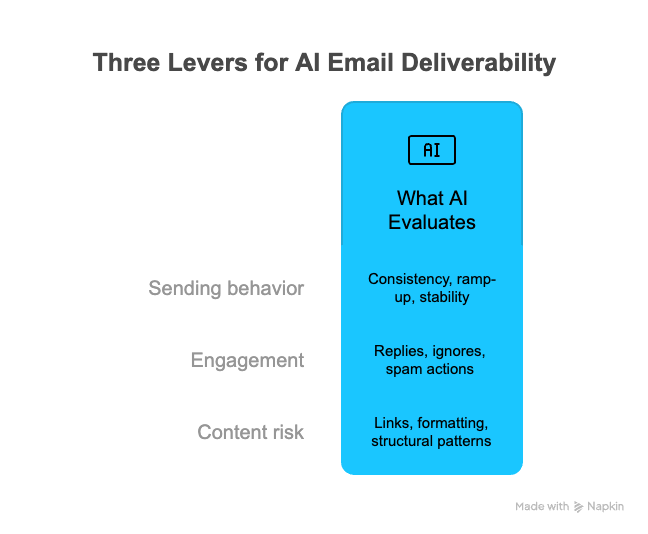
Trois leviers pour la délivrabilité email IA
Le placement en boîte de réception est déterminé au niveau du domaine, en fonction du comportement sur la durée. Pour gagner et maintenir la confiance de l'IA des fournisseurs de boîtes mail, les équipes B2B d'outbound doivent maîtriser trois leviers :
Un comportement d'envoi prévisible Une montée en puissance progressive et un volume quotidien constant aident l'IA à associer un domaine à une activité stable et humaine. Les pics soudains ou les schémas irréguliers signalent un risque et limitent le placement en boîte de réception.
Des signaux d'engagement soutenus Les réponses, les réponses positives et la récupération de spam renforcent la réputation de l'expéditeur. L'email warmup automatisé aide à maintenir ces signaux pendant les campagnes actives, compensant les baisses naturelles d'engagement.
Un risque de contenu réduit Les spam tests identifient les liens, le formatage ou les éléments de suivi qui augmentent le risque de filtrage. Ces vérifications réduisent les pénalités, mais ne créent pas de confiance, celle-ci étant gagnée par l'engagement.
Ensemble, ces leviers protègent le placement en boîte de réception avant que la réputation ne décline. Maintenant que nous avons vu comment l'IA influence la délivrabilité, il est important de comprendre quels outils sont conçus pour gérer efficacement ces signaux d'engagement et de réputation.
Les meilleurs outils de délivrabilité email IA en 2026
Outil
Capacité IA principale
Idéal pour
Point fort
Limites
MailReach
email warmup IA, détection des risques de spam, surveillance de la réputation
Équipes et agences d'outbound B2B
Stabilisation de l'engagement au niveau du domaine + spam tests + fonctionnalité Autofix IA
Spécifiquement axé sur la délivrabilité (pas une suite de vente complète)
Lemwarm
email warmup automatisé
Équipes de vente utilisant Lemlist
Intégration facile avec l'écosystème Lemlist
Diagnostics de spam avancés limités
GlockApps
Placement en boîte de réception et spam testing
Équipes marketing
Diagnostics de spam testing performants
Pas conçu spécifiquement pour les signaux d'engagement outbound à froid
Folderly
Conseil en délivrabilité + outils d'IA
Expéditeurs grands comptes
Accompagnement personnalisé pour la remédiation
Coût plus élevé ; plus axé sur les grandes entreprises
Une délivrabilité durable commence avec un support IA intelligent
Le placement en boîte de réception dépend aujourd'hui de la constance avec laquelle vous gérez la réputation de votre expéditeur. Les systèmes de filtrage basés sur l'IA réévaluent continuellement la confiance du domaine en fonction des schémas d'engagement et du comportement d'envoi. Les corrections ponctuelles ne suffisent pas.
MailReach aide les équipes outbound B2B à maintenir une réputation d'expéditeur stable sur le long terme. Son email warmup favorise des signaux d'engagement cohérents. Le spam testing identifie les risques liés au contenu avant que les campagnes ne prennent de l'ampleur. Une analyse continue aide à détecter les changements de réputation tôt, avant que le placement en boîte de réception ne diminue.
Si l'e-mail est un moteur de pipeline et de revenus pour votre entreprise, la délivrabilité ne peut pas être laissée au hasard. Protégez votre délivrabilité d'e-mails B2B avec MailReach et gardez vos e-mails dans la boîte de réception, là où ils doivent être.
Les problèmes de deliverability coûtent cher. Corrigez-les rapidement.
Chaque email dans le spam équivaut à un client potentiel perdu. Commencez dès aujourd'hui à améliorer le placement de vos emails dans la boîte de réception grâce aux spam tests et au warmup de MailReach.
Offre de printemps : Obtenez 20 % de réduction pendant les 30 premiers jours de warmup de votre première boîte mail – Commencez maintenant 🎉
Uniquement pour l'activité de cold outreach B2B
Vos emails ne peuvent pas stimuler la croissance si personne ne les voit.
Que vous envoyiez des emails de prospection ou que vous fassiez un suivi auprès de leads, un bon warmup garantit que vos emails soient vus. Assurez-vous que vos meilleures campagnes ne soient pas gaspillées.
Assurez-vous que vos emails atteignent la boîte de réception.
Une blacklist seule ne va pas toujours ruiner votre deliverability, mais ça vaut la peine de vérifier. Analysez les problèmes, effectuez un spam test et obtenez des prochaines étapes claires.
Vos cold emails B2B méritent une excellente deliverability.
Suivre les règles ne suffit pas—sachez où atterrissent vos emails et ce qui les retient. Vérifiez votre spam score avec notre test gratuit et améliorez la deliverability avec le warmup MailReach.
Commencez à utiliser MailReach dès maintenant et profitez de 20% de réduction sur le premier mois de notre plan Pro.
Des bases solides. Une deliverability parfaite. Commencez ici.
Vérifiez ce qui est à l'origine de vos problèmes d'email, corrigez ce qui est cassé et améliorez la deliverability grâce à des informations exploitables.
Arrêtez de perdre des revenus à cause d'une mauvaise deliverability.
Une mauvaise configuration du domaine ou des problèmes d'email pourraient vous empêcher d'atteindre les boîtes de réception. Testez la santé de vos emails et corrigez-la en quelques minutes.
Sans le bon warmup, vos meilleures campagnes ne servent à rien. Vous pouvez commencer par tester votre placement en boîte de réception et commencer à l'améliorer dès aujourd'hui.
Les blacklists empêchent-elles vos emails d'arriver dans la boîte de réception ?
Ce n'est pas parce que vous êtes listé que votre deliverability est condamnée. Lancez un spam test pour voir si vos emails arrivent réellement ou s'ils sont bloqués.
Vous pensez que votre cold outreach ne fonctionne pas ? Vérifions ça.
De superbes emails ont besoin d'une excellente deliverability. Testez votre placement maintenant et assurez-vous que vos emails arrivent là où ils devraient.
Nous allons vous révéler la stratégie d'envoi et de warmup la plus efficace en matière de délivrabilité d'e-mails à froid pour éviter d'atterrir dans les spams. Préparez-vous, c'est ultra efficace pour améliorer la délivrabilité de vos cold emails et obtenir d'excellents résultats lors de vos campagnes.

 Deliverability des Emails
.png)

.avif)