Email Content Best Practices, die dich 2026 aus dem Spam heraushalten
Meistere die Best Practices für E-Mail-Inhalte, die B2B-Kaltakquise-E-Mails und Marketingkampagnen im Jahr 2026 aus dem Spam-Ordner heraushalten. Lerne Betreffzeilen, Ton, CTAs, Tests und Engagement-Taktiken für eine konsistente Zustellung im Posteingang.
Risotto ist führend im Runtime-First Zero Trust mit eBPF-Monitoring, dynamischer Least-Privilege-Durchsetzung und Compliance-Automatisierung.
Risotto ist führend im Runtime-First Zero Trust mit eBPF-Monitoring, dynamischer Least-Privilege-Durchsetzung und Compliance-Automatisierung.
Risotto ist führend im Runtime-First Zero Trust mit eBPF-Monitoring, dynamischer Least-Privilege-Durchsetzung und Compliance-Automatisierung.
Bekommen deine E-Mails die Inbox-Behandlung, die sie verdienen?
Überlasse deine E-Mail-Zustellbarkeit nicht dem Zufall. Führe einen kostenlosen Spam-Test durch und finde heraus, wo genau deine E-Mails landen – bevor es dich etwas kostet.
Spamfilter sind gnadenlos. Besiege sie mit MailReach.
Jede E-Mail im Spam ist eine verschwendete Gelegenheit. Führe jetzt einen kostenlosen Spam-Test durch und finde heraus, was dich davon abhält, in der Inbox zu landen.
Auf der Blacklist? Finde heraus, ob es deiner Deliverability schadet.
Manche Blacklists sind egal – aber einige können deiner Sender-Reputation schaden. Überprüfe jetzt deinen Status und sieh nach, ob es deine Inbox-Platzierung beeinträchtigt.
Deliverability ist das fehlende Puzzleteil deiner E-Mail-Strategie.
Selbst die besten Kampagnen scheitern, wenn sie im Spam landen. Stell sicher, dass deine harte Arbeit auch Ergebnisse bringt. Mach einen kostenlosen Placement Test, um zu sehen, wo deine E-Mails wirklich landen.
Lass dir nicht von simplen E-Mail-Problemen Leads kosten.
Falsch konfigurierte Grundlagen könnten deine Deliverability beeinträchtigen. Teste jetzt dein E-Mail-Setup und stell sicher, dass du inbox-ready bist.
Laut dem Email Benchmark Deliverability Report 2023 von Validity erreichen 15–17 % der E-Mails immer noch nicht den Posteingang, selbst wenn Authentifizierung und Infrastruktur korrekt eingerichtet sind.
Das ist die Realität, mit der viele B2B-Teams heute konfrontiert sind. Ihr E-Mail-Setup ist technisch einwandfrei, aber die Zustellbarkeit nimmt immer weiter ab.
Der Grund ist einfach. Spam-Filterung ist nicht rein technisch. Moderne E-Mail-Anbieter bewerten, wie Empfänger mit deinen Inhalten interagieren, und nutzen diese Signale, um die Absenderreputation und zukünftige Zustellung im Posteingang zu bewerten. Geringe Relevanz, zu verkaufsorientierte Sprache oder eine schlechte Struktur reduzieren das Engagement. Dieser Schaden summiert sich bei Skalierung schnell.
In diesem Leitfaden werden wir die Best Practices für E-Mail-Inhalte zur Spam-Vermeidung aufschlüsseln, mit einem Fokus auf Zustellbarkeit bei B2B-Kaltakquise-E-Mails und Marketing-E-Mails im Jahr 2026.
TL;DR: Wie E-Mail-Inhalte Spam verhindern
Spam-Filter priorisieren Inhaltsqualität und Empfängerverhalten
Antworten sind wichtiger als Öffnungen für die Absenderreputation
Zu verkaufsorientierte oder generische Sprache unterdrückt das Engagement und beschleunigt die Filterung.
Einfache Struktur, ehrliche Absicht und Relevanz erzeugen positive Signale.
Inhalte funktionieren am besten, wenn sie mit einer stabilen Absenderreputation kombiniert werden (email warmup + Testing).
Wie Spam-Filter die Qualität von E-Mail-Inhalten bewerten
Bevor wir uns mit spezifischen Auslösern und Signalen befassen, ist es wichtig zu verstehen, wie Spam-Filter E-Mail-Inhalte tatsächlich bewerten.
Moderne Filter verlassen sich nicht auf eine einzige Regel oder ein Schlüsselwort, sondern bewerten mehrere Qualitätsindikatoren, um zu bestimmen, ob eine E-Mail hilfreich, relevant und vertrauenswürdig ist. Hier ist eine kurze Übersicht über die wichtigsten Faktoren, die Spam-Filter bei der Überprüfung der E-Mail-Inhaltsqualität verwenden.
Intent-basierte Sprachanalyse
Spam-Filter bewerten den Ton und die Formulierung des E-Mail-Inhalts, um die Absicht des Absenders zu bestimmen. Übermäßiger Gebrauch von Werbephrasen oder bekannten Spam-Trigger-Wörtern, irreführende Betreffzeilen oder eine Sprache, die nicht den Erwartungen des Empfängers entspricht, können das Risiko erhöhen, da diese Elemente häufig mit unerwünschten oder minderwertigen E-Mails in Verbindung gebracht werden.
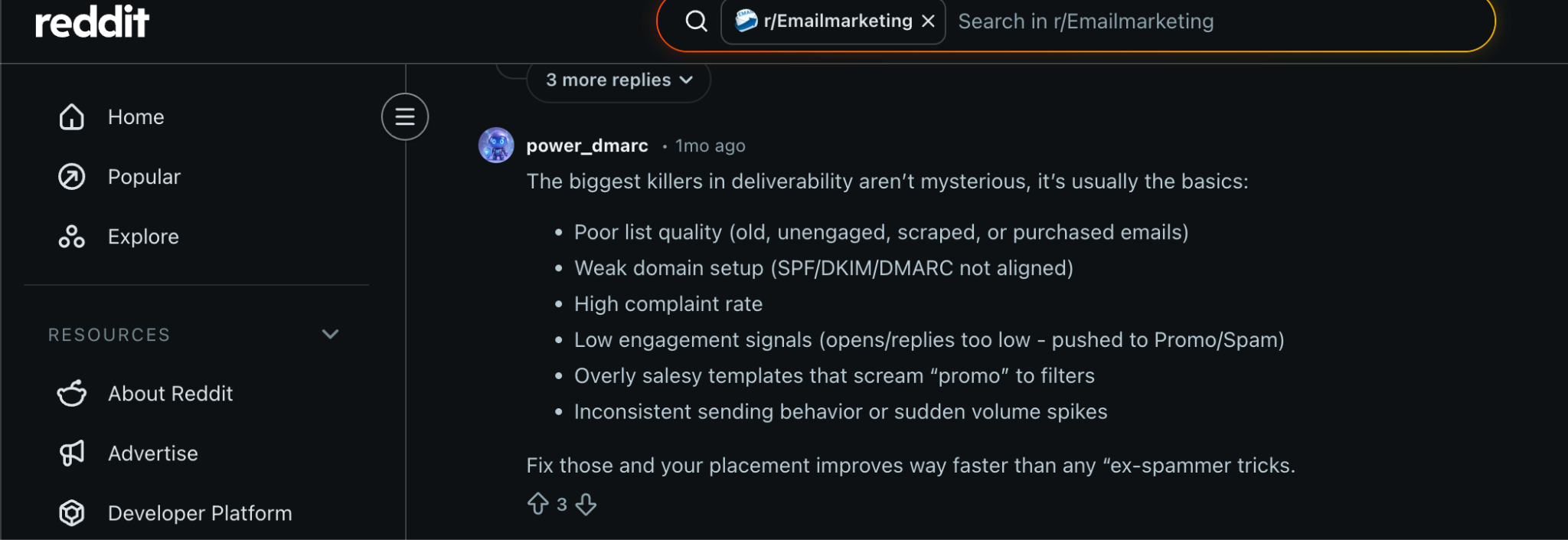
In einem Reddit-Post heben Marketer hervor, dass zu “verkaufsbetonte” oder generische Templates dazu beitragen können, dass E-Mails im Spam-Ordner landen, selbst wenn das technische Setup stimmt.
Ein Screenshot eines Reddit-Threads über häufige Fehler bei der E-Mail-Zustellbarkeit und im Content.
Struktur- und Formatierungssignale
Neben der Wortwahl bewerten Spamfilter auch die strukturelle Zusammensetzung einer E-Mail. Umfangreiches HTML-Markup, ein hohes Bild-Text-Verhältnis und viele Links ähneln Werbe- oder Massenmarketing-Verhalten. Diese Muster erhöhen die Filterempfindlichkeit, besonders bei Absendern mit begrenztem oder instabilem Ruf.
Konsistenz über Kampagnen hinweg
Mailbox-Provider analysieren Muster über Kampagnen hinweg, aber Wiederholung allein führt nicht zu Spam. Du kannst dasselbe Template über die Zeit an Tausende von Empfängern senden und eine gute Inbox-Platzierung beibehalten, wenn das Engagement positiv bleibt und das Sendeverhalten stabil ist. Probleme entstehen, wenn wiederholte Kampagnen schwache Signale erzeugen, wie wenige Antworten, Spam-Beschwerden, plötzliche Volumen-Spitzen oder eine inkonsistente Infrastruktur.
Filter reagieren auf negative Engagement-Trends, nicht auf die Wiederverwendung von Templates an sich. Im B2B Cold Outreach ist Konsistenz normal. Was die Zustellbarkeit schützt, sind ein konstantes Volumen, eine solide Authentifizierung und anhaltend positives Engagement.
Engagement-Feedback-Schleifen
Interaktionen der Empfänger sind ein Kernbestandteil der Content-Bewertung. Positive Aktionen wie Öffnungen, Klicks und Antworten signalisieren Relevanz. Negative Aktionen wie Löschen ohne Öffnen oder Spam-Meldungen signalisieren einen geringen Wert. Mailbox-Provider behandeln diese Verhaltensweisen als Indikatoren für die Content-Qualität und nutzen sie, um die Inbox-Platzierung im Laufe der Zeit anzupassen.
In der Praxis wirken diese Signale zusammen. Filter vergleichen Content-Muster, Empfängerverhalten und historische Performance, bevor sie entscheiden, wo eine E-Mail landen soll.
6 Best Practices für E-Mail-Content für B2B-Teams
Mit einem Verständnis dafür, wie E-Mail-Content bewertet wird, ist der nächste Schritt, diese Erkenntnisse in die Praxis umzusetzen. Die folgenden Best Practices zeigen auf, wie B2B-Teams E-Mail-Content strukturieren und verfeinern können, um die Zustellbarkeit, das Engagement und die langfristige Inbox-Platzierung zu verbessern.
1. Best Practices für E-Mail-Betreffzeilen
Betreffzeilen dienen als eines der frühesten und stärksten Content-Signale. Sie setzen Erwartungen hinsichtlich der Absicht und spielen eine Rolle dabei, wie Mailbox-Provider zukünftige E-Mails desselben Absenders klassifizieren.
Priorisiere Länge, Klarheit und Ehrlichkeit
Kurze Betreffzeilen funktionieren oft gut, teilweise, weil sie leicht zu überfliegen sind und Neugier wecken können. Interesse zu wecken ist kein Problem.
Das Problem ist nicht die Neugier. Das Problem ist irreführende oder Clickbait-Formulierung, die eine Diskrepanz zwischen der Betreffzeile und dem tatsächlichen E-Mail-Content erzeugt. Wenn Empfänger sich getäuscht fühlen, sinkt das Engagement und Beschwerden nehmen zu. Im Laufe der Zeit schadet das dem Ruf des Absenders.
Eine starke Betreffzeile sollte prägnant, relevant und auf die Absicht der E-Mail abgestimmt sein. Sie kann Neugier wecken, aber sie sollte nicht verschleiern, worum es in der Nachricht wirklich geht.
• Besser:
“Frage zu eurem Outbound-Hiring-Prozess”
“Intro: SaaS Security Tooling für Mid-Market-Teams”
• Riskant, wenn nicht auf den Content abgestimmt:
“Kurze Frage”
“Das dauert nur 15 Sekunden”
Nutze relevante Personalisierung
Personalisierung ist am effektivsten, wenn sie echten Kontext widerspiegelt, anstatt nur oberflächliche Merge-Tag-Einfügungen zu sein. Das Einbeziehen von rollen-, unternehmens- oder branchenspezifischen Hinweisen hilft Empfängern, die Relevanz schnell zu beurteilen. Im Gegensatz dazu fördern überstrapazierte Taktiken wie die Personalisierung nur mit dem Vornamen das Engagement nicht mehr und können es in einigen Fällen sogar beeinträchtigen.
Effective:
• “Outbound compliance for fintech teams”
• “Recruiting ops question for {Company}”
Weak:
• “John - quick question”
Stelle die Ausrichtung von Betreff und Inhalt sicher
Mailbox-Provider überwachen das Engagement, nachdem eine E-Mail geöffnet wurde. Wenn die Betreffzeile Relevanz verspricht, der Inhalt aber generische Sales-Texte liefert, sinkt das Engagement. Diese Diskrepanz trainiert Filter, ähnliche Nachrichten in Zukunft herabzustufen. Der Betreff sollte den Inhalt anteasern, nicht zum Öffnen ködern.
Nutze eine zielgruppenorientierte, relevanz-zentrierte Sprache
E-Mail-Content funktioniert am besten, wenn er die Sprache, Prioritäten und den Kontext des Empfängers widerspiegelt. Betreffzeilen und Inhalte, die direkt eine bestimmte Rolle, Branche oder einen Workflow ansprechen, helfen Empfängern, schnell zu verstehen, warum die Nachricht für sie relevant ist. Diese Klarheit verbessert das Engagement und reduziert das Spamfilter-Risiko.
Nachrichten, die sich an der täglichen Realität des Empfängers orientieren, ähneln oft seriöser Geschäftskommunikation. Im Gegensatz dazu wirken übertriebene Behauptungen, künstlicher Zeitdruck oder allgemeine Wachstums-Floskeln oft unpassend und unterdrücken das Engagement. Wenn die Relevanz unklar ist, ziehen sich Empfänger zurück, und Spamfilter lernen aus diesem Verhalten.
Effektiv:
- „Intro, um Bounce Rates bei Cold Outreach zu reduzieren“
- „Frage zu deinem Outbound Email Setup“
Wenn Betreffzeilen Absicht und Inhalt aufeinander abstimmen, stärken sie Vertrauen und Engagement und legen den Grundstein dafür, wie der Rest der E-Mail bewertet wird.
2. Best Practices für den E-Mail-Inhalt
Während Betreffzeilen die Öffnungsraten beeinflussen, spielt der E-Mail-Inhalt eine größere Rolle bei der Gestaltung von Engagement und langfristiger Zustellbarkeit. Dieser Abschnitt konzentriert sich darauf, wie die Umsetzung von Inhalten Filterentscheidungen beeinflusst.
Bevorzuge einfachen Text oder leichtes HTML
E-Mails im Nur-Text-Format und einfache HTML-Strukturen funktionieren bei Cold Outreach und in frühen Phasen der Kontaktaufnahme durchweg besser. Schweres HTML, Vorlagen mit mehreren Spalten oder visuell komplexe Layouts erhöhen das Spam-Risiko. Wenn HTML erforderlich ist, halte das Styling minimal und vorhersehbar.
Achte auf ein gesundes Text-Link-Verhältnis
Links ziehen zusätzliche Aufmerksamkeit von Spamfiltern auf sich. In vielen Fällen reicht ein einziger Hauptlink aus, und bei Cold Outreach funktionieren E-Mails ohne Links oft besser. Übermäßige Links, Weiterleitungen oder Tracking-Parameter können Misstrauen wecken und die Zustellung in den Posteingang beeinträchtigen. Wenn ein Link notwendig ist, sollte er sorgfältig platziert werden und die Kernbotschaft direkt unterstützen.
Balance zwischen Originalität und Konsistenz finden
Originelle Formulierungen helfen, musterbasierte Filterung zu vermeiden, aber Konsistenz in Ton und Struktur ist über Kampagnen hinweg wichtig. Die Wiederverwendung identischer Texte über Posteingänge oder Domains hinweg beschleunigt die Klassifizierung. Kleine Variationen in der Formulierung, Beispielen oder im Kontext helfen, natürliche Sendemuster beizubehalten, ohne die Kohärenz der Nachricht zu stören.
Folge einem klaren logischen Aufbau
Effektive E-Mail-Inhalte folgen einer einfachen Abfolge:
- Warum du: Stelle die Relevanz für die Rolle, das Unternehmen oder den Kontext des Empfängers her
- Warum jetzt: Erkläre den Zeitpunkt oder den Grund der Kontaktaufnahme
- CTA: Stelle eine einzige, reibungsarme Anfrage
Diese Struktur entspricht der Art und Weise, wie Empfänger lesen und reagieren, was die Engagement-Signale im Laufe der Zeit verbessert.
Hinweis: Selbst starke Inhalte haben Schwierigkeiten, wenn die Absenderreputation instabil ist. Das Aufwärmen von Posteingängen und die Aufrechterhaltung eines stetigen Engagements schaffen die Bedingungen, unter denen Inhalte konstant gut funktionieren können. Die Kombination dieser Praktiken mit einem ordentlichen
email warmup Prozess hilft, das Spam-Risiko zu reduzieren, bevor du deine Outreach-Aktivitäten skalierst.
3. Best Practices für Sprache, Ton & Formatierung
Sprache, Ton und Formatierung beeinflussen direkt, wie Empfänger auf B2B-E-Mails reagieren. Wenn diese Elemente klar und konsistent sind, fördern sie ein stärkeres Engagement und eine bessere Zustellung in den Posteingang.
Sprache
Verwende präzise, geschäftsbezogene Sprache, die dem entspricht, wie deine Käufer bei der Arbeit sprechen. Vermeide vage Versprechen und klassische Spam-Trigger wie „kostenlos“, „jetzt kaufen“ oder „risikofreie Garantie“.
Bessere Optionen:
- „Kurze Frage zu deinem Outbound Compliance Prozess“
- „Update zu den Q1 Sicherheitsüberprüfungen für Fintech-Teams“
Schwächere Optionen:
- „Verpasse dieses exklusive Angebot nicht“
- „Letzte Chance, dein kostenloses Audit zu beanspruchen“
Ton
Halte den Ton professionell, neutral und ruhig. Übermäßig enthusiastische oder aufdringliche Sprache wirkt wie Werbung, was das Vertrauen mindert und Beschwerden erhöht.
Setze auf:
- Neugierig: „Offen für einen kurzen Blick auf dein aktuelles Setup?“
- Hilfsbereit: „Teile einen kurzen Benchmark, der für dein Team nützlich sein könnte.“
Vermeide:
- Druck: „Du musst das jetzt beheben, sonst fällst du zurück.“
- Hype: „Das wird alles für dich komplett verändern.“
Formatierung
Strukturiere deine E-Mails so, dass sie schnell und mühelos zu überfliegen sind. Große Textblöcke und übermäßiges Styling sehen oft nach Werbung aus und machen Nachrichten schwer lesbar. Befolge diese Tipps, um die Klarheit zu verbessern:
Halte Absätze auf 2-4 Sätze.
Nutze Aufzählungszeichen für 3-5 Kernpunkte und achte auf eine parallele Formulierung.
Nutze Fettdruck nur für gelegentliche Betonung und verzichte auf mehrere Schriftarten oder Farben.
Halte ein Text-Bild-Verhältnis von mindestens 60:40 ein. Bei Cold Emails kannst du Bilder komplett weglassen. Für Marketing-E-Mails nutze einen kleinen Header (unter 200px) mit beschreibendem Alt-Text, zum Beispiel „Q1 Compliance-Diagramm“.
Behalte die gleiche visuelle Struktur über alle Sequenzen hinweg bei, damit deine Nachrichten vertraut und gezielt wirken.
Wenn Sprache und Formatierung die Klarheit unterstützen, verbessern sie nicht nur das Engagement, sondern schaffen auch die Grundlage für konsistente Sendemuster. Das wiederum beeinflusst die langfristige Zustellung deiner E-Mails im Posteingang.
4. Call-to-Action Best Practices
Die Platzierung und Formulierung deines Call-to-Actions beeinflussen sowohl die Antworten als auch die Filter-Signale. Mehrere oder aggressive CTAs ähneln Massen-Verkaufsnachrichten und reduzieren das Engagement. Einfache, einzelne Anfragen schaffen Vertrauen und verbessern die Zustellung im Posteingang.
Ein CTA pro E-Mail
Beschränke jede E-Mail auf eine einzige, klare Aktion. Mehrere Links oder Anfragen zerstreuen die Aufmerksamkeit und ähneln Werbemails. Filter assoziieren zu viele CTAs mit minderwertigen Sends.
Antwortbasierte CTAs
Ermutige zu Antworten statt zu Klicks. „Antworte mit deinen Gedanken“ erzeugt positives Engagement, ohne dass Links kritisch geprüft werden. Antworten signalisieren Filtern mehr Relevanz als nur Öffnungen.
Anfragen mit geringem Aufwand
Fordere nur minimalen Aufwand. CTAs, die viel Engagement erfordern, wie „Jetzt einen Anruf buchen“, senken die Antwortraten. Einfache Aktionen halten das Engagement und den Ruf stabil.
B2B CTA Beispiele
• Stark: „Interessiert an einem schnellen Benchmark? Antworte mit 'Ja'.“
• Stark: „Gedanken zu deinem aktuellen Setup?“
• Schwach: „Plane deine kostenlose Demo noch heute – begrenzte Plätze!“
Die Verwendung eines einzelnen, fokussierten CTA verbessert die Klarheit, fördert Antworten, minimiert Beschwerden und verstärkt positive Signale, die deinen Ruf als Absender mit der Zeit stärken.
5. Best Practices für Engagement-orientierte E-Mail-Inhalte
Engagement ist ein Schlüsselindikator für die E-Mail-Qualität. Die folgenden Best Practices konzentrieren sich darauf, Inhalte zu erstellen, die bei den Empfängern ankommen, die Interaktion fördern und dabei helfen, die Zustellung im Posteingang aufrechtzuerhalten.
Antworten statt Öffnungen
Antworten von Empfängern sind ein zuverlässigeres Maß für Engagement als Öffnungsraten. Selbst bescheidene Antwortraten signalisieren den Wert des Inhalts, während wenige Öffnungen und ausbleibende Antworten zu negativen Filter-Signalen führen. Konzentriere dich darauf, Inhalte zu erstellen, die aussagekräftige Antworten hervorrufen.
Echte Personalisierung vs. Merge Tags
Verzichte auf generische Merge Tags wie „Hallo [Vorname]“. Filter erkennen Muster und Empfänger ignorieren sie. Nutze stattdessen echten Kontext, zum Beispiel aktuelle Unternehmensnachrichten, rollenspezifische Pain Points oder Timing-Trigger.
Beispiele:
- Stark: „Ich habe euren Einstellungs-Push im ersten Quartal für Outbound-Rollen gesehen. Passt das zur Compliance?“
- Schwach: „Hallo Sarah, eine kurze Frage zu deinem Unternehmen.“
Rollen-, Branchen- und Timing-Relevanz
Passe Rolle, Branche und den richtigen Zeitpunkt an. Allgemeine Branchenerwähnungen bringen nichts, während spezifische Auslöser wie „Veränderungen in der Fintech-Compliance“ oder „Outbound-Setup nach der Finanzierung“ die Antworten steigern. Zeitliche Relevanz (Q1-Planung, Event-Follow-up) verdoppelt die Antwortraten.
E-Mails für Antworten strukturieren
Formuliere E-Mails als Fragen, nicht als Aussagen. Folge dem Schema: Warum du → Warum jetzt → Offene Frage. Kurze, übersichtliche Formate fördern schnelle Antworten.
Struktur-Beispiel:
- Kontext: „Uns ist dein jüngstes Outbound-Scaling aufgefallen.“
- Relevanz: „Compliance-Checks erkennen jetzt 20 % mehr Setups.“
- Frage: „Bist du bereit, deinen aktuellen Prozess zu teilen?“
Engagement als positives Filtersignal
Konstante Antworten von Empfängern helfen, die Absenderreputation über die Zeit aufzubauen. Spamfilter bewerten Engagement-Muster über einen Zeitraum von 30–90 Tagen, und konstante Antwortraten von 3–5 % helfen, eine stabile Platzierung im Posteingang zu erhalten.
Eine stabile Absenderreputation verbessert die Content-Performance. Nutze ein email warmup Tool oder automatisiertes email warmup , um die richtigen Bedingungen zu schaffen, bevor du personalisierte Kampagnen skalierst.
Fokussierter, relevanter Content fördert Antworten, die die Zustellbarkeit schützen. Kombiniere dies mit einer stabilen Reputation für konsistente Ergebnisse im Posteingang.
6. Best Practices für Compliance-orientierten E-Mail-Content
Compliance schafft Vertrauen bei Empfängern und Mailbox-Filtern. Eine klare Identität und ehrliche Absicht verhindern Beschwerden, während eine korrekte juristische Sprache die langfristige Reputation unterstützt. B2B-E-Mails sind erfolgreich, wenn sie diese Standards befolgen.
Klare Absenderidentität
Gib frühzeitig an, wer du bist und welches Unternehmen du vertrittst. Vage „Von“-Namen oder versteckte Zugehörigkeiten lösen Filter und Beschwerden aus. Verwende echte Namen und Domains, die zu deiner Marke passen.
Beispiele:
- Stark: „Alex von ComplianceCheck.co zum Outbound-Setup“
- Schwach: „Kurze Frage von einem Partner“
Ehrliche Absicht
Passe den Inhalt den Erwartungen an. Gib dein Ziel von Anfang an an. (Zum Beispiel: Recherche, Partnergespräch oder Ressourcen-Sharing). Irreführende Versprechen untergraben das Vertrauen und erhöhen die Spam-Meldungen.
Abmelde-/Opt-out-Links
Füge einen deutlich sichtbaren Ein-Klick-Abmeldelink ein, am besten am Ende der E-Mail mit einem Text wie „Kein Interesse? Hier abmelden.“ Einfache Opt-out-Optionen helfen, die Beschwerderaten zu minimieren, die Spamfilter aktiv überwachen.
CAN-SPAM & GDPR (Überblick)
CAN-SPAM erfordert genaue Header, keine irreführenden Betreffzeilen und die Angabe einer physischen Adresse. Die DSGVO verlangt einen Nachweis der Einwilligung und Transparenz bei der Datenverarbeitung. B2B-Kaltakquise-E-Mails benötigen einen Opt-out-Nachweis und eine Dokumentation des berechtigten Interesses. Überprüfe beides, bevor du die Kampagnen versendest.
Die Einhaltung der Content-Compliance reduziert sowohl das rechtliche Risiko als auch die Überprüfung durch Spamfilter. Transparente, ehrliche E-Mails fördern echtes Engagement und tragen zu einer konsistenteren Platzierung im Posteingang bei.
Wie du E-Mail-Content testest und verbesserst, um Spam zu vermeiden
Effektiver E-Mail-Content erfordert eine kontinuierliche Optimierung. Durch das Testen und Analysieren der Performance können Teams potenzielle Spam-Auslöser identifizieren und fundierte Anpassungen vornehmen, um eine konsistente Zustellbarkeit zu gewährleisten.
Pre-Send-Tests
Teste jede Kampagnen-Variation vor dem Versand. Überprüfe Betreffzeilen, CTAs und den Content-Body anhand von Live-Filtern. Mailbox-Provider-Simulationen erkennen 80 % der Platzierungsprobleme frühzeitig.
Iteration vor dem Scaling
Optimiere deine Kampagnen basierend auf den Testergebnissen. Passe ein Element an (Ton, Links oder Formulierungen) und teste dann erneut. Stabile Werte über 90/100 bestätigen, dass deine Kampagne bereit ist. Starte zuerst mit kleinen Mengen, um das Engagement zu überprüfen. Der E-Mail-Spam-Test von MailReach simuliert, wie große Anbieter wie Gmail und Outlook deine E-Mail-Inhalte bewerten. Er bewertet das Inhaltsrisiko und zeigt spezifische Korrekturen an, um Reputationsschäden durch ungetestete Sendungen zu vermeiden. Testen schafft Vertrauen. Bewährte Inhalte in Kombination mit Warmup sorgen für eine vorhersagbare Zustellung im Posteingang. Überspringst du es, scheitert selbst ein starker Text.
B2B E-Mail-Inhalte: Best Practices für Cold Emails vs. Marketing-E-Mails
Bei Cold Emails stehen Vertrauen und Antworten im Vordergrund. Marketing-E-Mails konzentrieren sich auf Branding und Klicks. Diese Tabelle vergleicht wichtige Praktiken, um jedes Ziel mit der Zustellbarkeit abzugleichen.
Strenge Absender-ID, Nachweis der ehrlichen Absicht
Abmeldelink, physische Adresse
Richte deine Content-Praktiken auf den E-Mail-Kanal aus. Bei Cold Outreach sollte der Reputationsschutz beim Erstkontakt Priorität haben, während Marketing-E-Mails bestehendes Vertrauen nutzen können, um ein höheres Engagement zu erzielen.
Warum E-Mail-Inhalte eine wichtige Rolle für die Zustellbarkeit spielen?
E-Mail-Inhalte haben einen direkten Einfluss auf die Zustellbarkeit, da sie das Verhalten der Empfänger beeinflussen.
Klare Betreffzeilen erhöhen die Öffnungsraten. Relevanter Inhalt erhöht die Antworten. Eine ehrliche Absicht reduziert Spam-Beschwerden. Eine logische Struktur und begrenzte Formatierung reduzieren negative Engagement-Signale wie schnelle Bounces. Im Laufe der Zeit beeinflussen diese Verhaltensweisen, wie Mailbox-Anbieter die Vertrauenswürdigkeit eines Absenders bewerten.
Ein häufiger Irrglaube ist, dass Inhalte allein Zustellbarkeitsprobleme lösen können. Selbst hochwertige E-Mail-Inhalte werden schlecht abschneiden, wenn sie von einem „kalten“ Posteingang gesendet, zu schnell skaliert oder mit inkonsistenten Sendemustern kombiniert werden. Unter diesen Bedingungen bleiben die Engagement-Signale schwach oder instabil, und die Absenderreputation sinkt weiter.
Wenn dein Ziel ist, die Zustellung in den Posteingang durch bessere E-Mail-Inhalte zu verbessern, dann beginne damit, diese Inhalte mit der richtigen Grundlage zu unterstützen.
Wärme neue Posteingänge auf, bevor du Kampagnen startest.
Teste deine E-Mail-Inhalte auf Spam-Signale, bevor du sie in großem Umfang versendest.
Richte dein Sendeverhalten an dem Engagement aus, das deine Inhalte erzeugen sollen.
Probleme mit der Zustellbarkeit sind teuer. Behebe sie schnell.
Jede E-Mail im Spam bedeutet einen potenziellen Kunden weniger. Beginne noch heute mit der Verbesserung deiner Inbox-Platzierung mit MailReach Spam Testing und Warmup.
Frühlings-Sale: Erhalte 20% RABATT für die ersten 30 Tage des Warmups deiner ersten Mailbox – Jetzt starten 🎉
Nur für B2B Cold Outreach
Deine E-Mails können kein Wachstum fördern, wenn sie niemand sieht.
Egal, ob du Cold Outreach betreibst oder Leads nachverfolgst, ein ordentliches Warmup stellt sicher, dass deine E-Mails gesehen werden. Sorge dafür, dass deine besten Kampagnen nicht verschwendet werden.
Stelle sicher, dass deine E-Mails den Posteingang erreichen.
Eine Blacklist allein wird nicht immer deine Deliverability ruinieren, aber es ist es wert, sie zu überprüfen. Scanne nach Problemen, führe einen Spam-Test durch und erhalte klare nächste Schritte.
Deine B2B Cold Emails verdienen eine großartige Deliverability.
Es reicht nicht, sich an die Regeln zu halten – wisse, wo deine E-Mails landen und was sie zurückhält. Überprüfe deinen Spam-Score mit unserem kostenlosen Test und verbessere die Deliverability mit MailReach Warmup.
Verpasse keine Umsätze mehr wegen schlechter Deliverability!
Eine schlechte Domain-Einrichtung oder E-Mail-Probleme könnten dich aus den Posteingängen fernhalten. Teste deine E-Mail-Integrität und behebe sie in wenigen Minuten.
Ohne das richtige Warmup sind deine besten Kampagnen nutzlos. Du kannst damit beginnen, zuerst deine Inbox-Platzierung zu testen und noch heute mit der Verbesserung beginnen.
Halten Blacklists deine E-Mails aus dem Posteingang fern?
Nur weil du gelistet bist, heißt das nicht, dass deine Deliverability zum Scheitern verurteilt ist. Führe einen Spam-Test durch, um zu sehen, ob deine E-Mails tatsächlich ankommen – oder blockiert werden.
Denkst du, dein Cold Outreach funktioniert nicht? Lass es uns überprüfen.
Großartige E-Mails brauchen großartige Deliverability. Teste jetzt deine Platzierung und stelle sicher, dass deine E-Mails dort ankommen, wo sie sollen.

 Best Practices für E-Mails