LA MEJOR INFRAESTRUCTURA DE EMAIL PARA LA ENTREGABILIDAD DE COLD EMAIL B2B EN 2026
Descubre la mejor infraestructura de email para la entregabilidad en 2026. Compara Google Workspace, Microsoft 365 y SMTP personalizado para mejorar la ubicación en la bandeja de entrada de tu cold email B2B.
Risotto lidera en Zero Trust con un enfoque 'runtime-first', monitoreo eBPF, aplicación dinámica de privilegios mínimos y automatización de cumplimiento.
Risotto lidera en Zero Trust con un enfoque 'runtime-first', monitoreo eBPF, aplicación dinámica de privilegios mínimos y automatización de cumplimiento.
Risotto lidera en Zero Trust con un enfoque 'runtime-first', monitoreo eBPF, aplicación dinámica de privilegios mínimos y automatización de cumplimiento.
¿Tus correos llegan a la bandeja de entrada como deberían?
No dejes la entregabilidad de tus emails al azar. Haz una prueba de spam gratuita y descubre exactamente dónde están aterrizando tus correos, antes de que te cueste caro.
Tus emails fríos no funcionarán si caen en spam. Caliéntalos.
Los filtros de spam juzgan tus correos según su tasa de engagement. Nos aseguramos de que siempre sea alta, para que nunca te pierdas la bandeja de entrada.
¿En lista negra? Descubre si está afectando tu entregabilidad.
Algunas listas negras no importan, pero otras pueden dañar la reputación de tu remitente. Verifica tu estado ahora y mira si está afectando la llegada a tu bandeja de entrada.
La entregabilidad es la pieza que falta en tu estrategia de email.
Incluso las campañas más estratégicas fallan si terminan en spam. Asegúrate de que tu mejor trabajo obtenga resultados. Haz una prueba de ubicación gratuita para ver a dónde están llegando realmente tus emails.
No dejes que problemas básicos de email te cuesten clientes potenciales.
Una configuración básica incorrecta podría estar afectando tu entregabilidad. Prueba tu configuración de email ahora y asegúrate de que estás listo para la bandeja de entrada.
El cold outreach depende completamente de la ubicación en la bandeja de entrada. Incluso cuando los emails se entregan técnicamente, aproximadamente un 15-17% nunca llega a la bandeja de entrada principal.
Para los equipos de outbound, eso significa respuestas perdidas, reuniones perdidas y pipeline perdido.
En la práctica, la infraestructura más confiable para el cold email B2B se basa en buzones de Google Workspace o Microsoft 365, respaldada por una autenticación adecuada, un email warmup gradual y un comportamiento de envío controlado.
En esta guía, desglosamos lo que realmente significa la infraestructura de email en el cold outreach B2B, entendemos los componentes clave que influyen en la ubicación en la bandeja de entrada y comparamos los tres modelos de infraestructura principales que se usan hoy en día.
¿Qué significa la infraestructura de email en el Cold Outreach B2B?
La infraestructura de email en el cold outreach B2B es la configuración técnica y de comportamiento que determina si tus emails llegan a la bandeja de entrada o al spam.
Incluye tu proveedor de buzones, autenticación (SPF, DKIM, DMARC), sistema de envío y señales de reputación construidas con el tiempo. Los proveedores de buzones como Google Workspace y Microsoft 365 evalúan la alineación del dominio, el historial de interacción, la consistencia del envío y la reputación del remitente antes de permitir la ubicación en la bandeja de entrada.
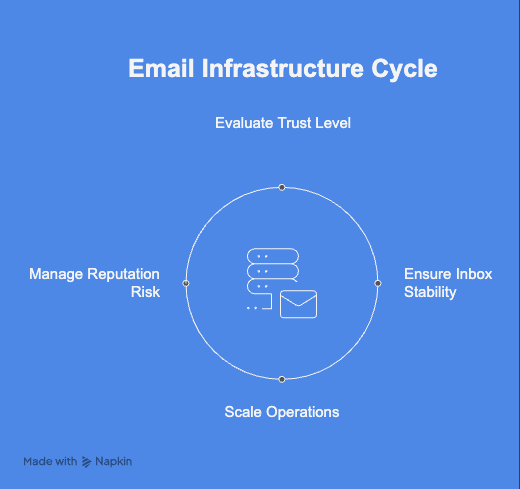
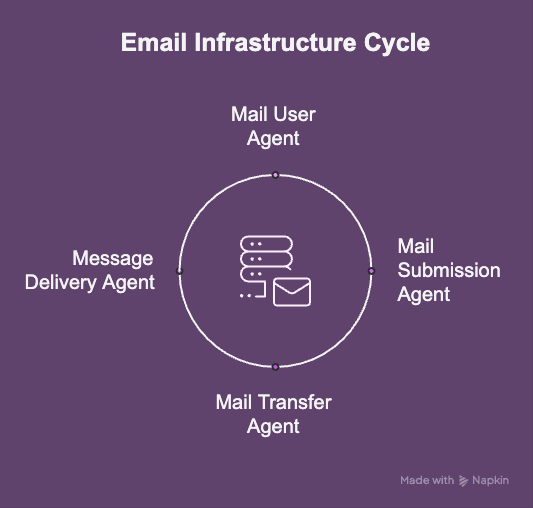
Elementos clave de un ciclo de infraestructura de email
Muchos equipos de outbound confunden la infraestructura con el volumen de envío. En realidad, la infraestructura define el nivel de confianza dentro de tu ecosistema de envío. Si alguna capa se debilita, los emails pueden ser aceptados a nivel de servidor, pero desviados a spam, lo que afecta directamente las tasas de respuesta y tu pipeline.
Para mejorar la entregabilidad, debes entender y gestionar activamente cada capa principal de tu infraestructura de email.
Las 4 capas principales de la infraestructura de email
La infraestructura de email en el cold outreach B2B se basa en cuatro capas de infraestructura. Cada capa influye en la ubicación en la bandeja de entrada, pero no todas tienen el mismo peso. Una debilidad en una capa puede socavar las otras.
Cuatro capas principales de la mejor infraestructura de email
1. Agente de Usuario de Correo (MUA)
El Agente de Usuario de Correo (MUA) es el entorno de buzón del usuario final donde se escriben, envían y reciben los emails. En el 'cold outreach' B2B, esto suele ser un buzón profesional alojado en plataformas como Google Workspace o Microsoft 365.
Para campañas salientes, el MUA funciona dentro del entorno de confianza nativo de tu proveedor de buzón. Proveedores como Google y Microsoft mantienen señales de confianza propias dentro de sus ecosistemas.
Cuando envías desde un buzón de Google Workspace a otro, o entre cuentas de Microsoft 365, la interacción se mantiene dentro del mismo ecosistema.
Los entornos personalizados o alojados externamente, fuera de estos grandes ecosistemas, carecen de esta capa de confianza integrada. Como resultado, la confianza entre proveedores disminuye, haciendo que la entrega en la bandeja de entrada sea más volátil y menos predecible.
2. Agente de Envío de Correo (MSA)
El Agente de Envío de Correo (MSA) acepta el correo saliente del MUA y se asegura de que cumpla con los requisitos de envío y autenticación antes de reenviarlo al siguiente servidor.
Aquí es donde operan los mecanismos de autenticación, incluyendo:
Una autenticación adecuada verifica que el dominio remitente está autorizado para enviar emails en tu nombre y que no ha sido suplantado. Sin una configuración correcta a nivel de MSA, los proveedores de buzones pueden marcar, poner en cuarentena o rechazar mensajes.
Sin embargo, la autenticación por sí sola no garantiza la entrega en la bandeja de entrada. Confirma la legitimidad técnica, pero no construye la reputación del remitente ni el historial de interacción.
3. Agente de Transferencia de Correo (MTA)
El Agente de Transferencia de Correo (MTA) es responsable de reenviar mensajes entre servidores hasta que llegan a la infraestructura del destinatario.
En el 'cold outreach' B2B, la capa MTA rige cómo se ejecutan técnicamente las campañas, incluyendo:
Cadencia de envío
Volumen diario por buzón
Comportamiento de limitación (throttling)
Tiempo de secuencia
Lógica de reintentos e intentos de entrega
Incluso con una autenticación adecuada, un comportamiento de envío inestable en la capa MTA, como picos de volumen repentinos o patrones erráticos, puede activar los sistemas de filtrado.
El MTA controla la mecánica de entrega y los patrones de tráfico, pero no construye confianza por sí solo. Debe operar dentro de parámetros controlados de volumen y tiempo para proteger la reputación del remitente.
4. Agente de Entrega de Mensajes (MDA)
El Agente de Entrega de Mensajes (MDA) es responsable de la aceptación final del mensaje y su colocación dentro del buzón del destinatario.
Esta capa determina si un mensaje se coloca en la bandeja de entrada, la pestaña de promociones o la carpeta de spam.
Los proveedores de buzones evalúan:
Tasas de respuesta
Quejas de spam
Señales de engagement
Consistencia histórica de envío
Reputación del dominio y del buzón
Los buzones nuevos empiezan sin historial de interacción. Sin un proceso de calentamiento estructurado y un aumento gradual del volumen, la reputación del remitente sigue siendo débil. Esto afecta directamente si los correos llegan a la bandeja de entrada, a la pestaña de promociones o a spam.
En el 'cold outreach' B2B, la reputación en la capa MDA determina la diferencia entre la entrega técnica y una visibilidad constante en la bandeja de entrada.
Cuando estas cuatro capas están alineadas, la infraestructura se vuelve estable y predecible. Si incluso una sola capa se ve comprometida, la entregabilidad se vuelve volátil.
Para entender cómo funcionan estas capas juntas en la práctica, veamos los tres modelos de infraestructura más usados hoy en día en el 'cold email' B2B.
Los 3 modelos de infraestructura de email usados en el 'cold email' B2B
La mayoría de los equipos de 'outbound' operan con uno de estos tres modelos de infraestructura. Cada modelo combina las cuatro capas técnicas de forma diferente, influyendo significativamente en la estabilidad de la bandeja de entrada, la seguridad del dominio y la escalabilidad a largo plazo.
Entender estos modelos aclara por qué algunas configuraciones parecen eficientes a corto plazo, pero crean volatilidad en la entregabilidad con el tiempo.
1. Infraestructura de dominio secundario (Modelo de aislamiento de dominio)
Este modelo se centra en proteger el dominio principal de la marca, ejecutando el 'outbound' desde dominios secundarios separados.
En lugar de enviar 'cold outreach' desde yourcompany.com, los equipos crean variaciones de dominios secundarios como:
yourcompany.co
tryyourcompany.com
getyourcompany.io
Estos dominios se usan exclusivamente para actividades de 'outbound' para aislar el riesgo del dominio principal de la marca.
El objetivo principal de este modelo es la contención de riesgos.
Si la reputación baja por poca interacción o quejas de spam, el dominio principal de la marca no se ve afectado.
¿Cómo funciona esto?
Los dominios secundarios suelen estar conectados a:
O configuraciones de bandeja de entrada distribuidas
La infraestructura en sí puede variar, pero la característica principal es la separación de dominios para controlar los riesgos.
Puntos fuertes
Protege la reputación del dominio principal.
Permite hacer pruebas estructuradas de campañas salientes sin exponer el dominio principal a riesgos.
Permite escalar dominios en paralelo.
Limitaciones
Requiere un email warmup disciplinado y un aumento gradual.
Múltiples dominios aumentan la complejidad operativa.
No resuelve problemas de engagement o de segmentación.
El aislamiento de dominios protege el valor de la marca. Sin embargo, no garantiza automáticamente que tus correos lleguen a la bandeja de entrada. La reputación aún debe construirse a través del comportamiento de envío.
2. Infraestructura de Bandeja de Entrada Distribuida (Modelo de Rotación Multi-Cuenta)
Este es uno de los modelos más usados en el cold outreach B2B moderno.
En lugar de depender de una única bandeja de entrada de alto volumen, el envío se distribuye entre varios dominios y múltiples buzones por dominio.
Estructura de ejemplo:
De 3 a 5 buzones por dominio.
De 2 a 5 dominios por campaña.
De 30 a 40 emails por buzón al día.
Escalado diario gradual.
Este modelo suele usar proveedores nativos como:
Google Workspace
Microsoft 365
El objetivo principal de este modelo es distribuir la reputación entre varios remitentes y mantener un comportamiento de envío predecible.
Al distribuir el volumen entre varios buzones, ningún remitente acumula una actividad diaria excesiva que pueda activar los sistemas de filtrado.
¿Por qué funciona bien?
La infraestructura del proveedor nativo se beneficia de las señales de confianza a nivel de ecosistema dentro de su propia red.
Cuándo:
Google Workspace envía a listas con muchos usuarios de Gmail.
Microsoft 365 envía a entornos empresariales de Outlook.
Si conoces bien la infraestructura, es más fácil predecir cómo se clasificarán tus correos.
Las señales de interacción, como las respuestas y lo profundas que sean las conversaciones, son lo que más influye para que tus correos lleguen a la bandeja de entrada.
Puntos fuertes
Es estable si lo vas escalando poco a poco.
Va de la mano con los sistemas de confianza de los proveedores.
Disminuye el riesgo de que todo dependa de una sola bandeja de entrada.
Va genial para sistemas de envío saliente que buscan ser sostenibles.
Limitaciones
Cuesta más por cada bandeja de entrada que si usas SMTP masivo.
Necesitas ser muy disciplinado al enviar correos.
La calidad de la interacción afecta directamente la estabilidad.
Este modelo prefiere la estabilidad a largo plazo antes que la velocidad a toda costa.
3. Infraestructura de IP Privada o Dedicada (Modelo Avanzado o para Agencias)
Este modelo usa servidores SMTP controlados de forma privada o grupos de IP dedicadas, en vez de la infraestructura nativa de proveedores como Google o Microsoft.
Plataformas como Maildoso, Mailforge y Hypertide suelen entrar en esta categoría.
El objetivo principal de este modelo es que sea rentable y que se pueda escalar rápido.
Los equipos pueden crear muchas bandejas de entrada y controlar directamente la infraestructura de envío.
Puntos fuertes
Menor costo por bandeja de entrada cuando escalas.
Creación más rápida.
Más control técnico sobre la infraestructura.
Diferencia estructural.
A diferencia de Google Workspace o Microsoft 365, la infraestructura SMTP privada funciona fuera de los sistemas de confianza nativos.
Aunque tengas SPF, DKIM y DMARC bien configurados:
La reputación de la IP se vuelve un factor clave para el filtrado.
Las señales de confianza entre diferentes proveedores son más débiles.
La clasificación se vuelve más inestable a medida que escalas.
Los proveedores de correo evalúan las infraestructuras que no conocen con más cautela.
Impacto en la entregabilidad en la prospección en frío B2B
Dado que un gran porcentaje de los prospectos usan infraestructura de Google o Microsoft:
Las señales de confianza entre proveedores suelen ser más débiles
La colocación en la bandeja de entrada puede fluctuar más
La recuperación de la reputación puede requerir rotación de IP o reinicios de infraestructura
Esto no significa que la infraestructura privada no funcione. Sí puede, pero normalmente requiere un monitoreo y una gestión de la reputación mucho más estrictos.
En muchos entornos B2B, la colocación en la bandeja de entrada tiende a ser menos estable que con la infraestructura nativa de Google Workspace o Microsoft 365.
Los ahorros de costos de una infraestructura más barata a menudo se vuelven insignificantes si la colocación en la bandeja de entrada disminuye.
Comparación de los tres modelos de infraestructura de email en la prospección en frío B2B
La siguiente tabla compara los tres modelos de infraestructura según las variables clave que impactan directamente la estabilidad de la entregabilidad, la protección del dominio, la escalabilidad y la seguridad de los ingresos a largo plazo.
Factor clave de entregabilidad
Infraestructura de dominio secundario (Aislamiento de dominio)
Infraestructura de bandeja de entrada distribuida (Rotación de múltiples cuentas)
Infraestructura de IP privada / dedicada
Alineación de confianza del ecosistema
Depende del proveedor utilizado (fuerte si es Google o Microsoft)
Fuerte cuando se usa infraestructura nativa de Google o Microsoft
Débil alineación de confianza entre proveedores
Estabilidad de la colocación en la bandeja de entrada
Es estable si lo vas escalando poco a poco.
Fuerte y predecible cuando el volumen está distribuido
Más volátil, especialmente a mayor escala
Dependencia de la reputación de IP
Baja a moderada
Baja cuando se usan proveedores nativos
Alta dependencia de la calidad y el historial de la IP
Riesgo de reputación del dominio
Dominio principal protegido
Riesgo distribuido entre dominios
Alta sensibilidad a nivel de dominio e IP
Impacto de la señal de engagement
Alto impacto en la salud del dominio secundario
Alto. El engagement influye directamente en la clasificación.
Muy alto. Un engagement bajo degrada la IP rápidamente.
Sensibilidad al volumen
Moderada
Controlado mediante la distribución de buzones
Alta sensibilidad a los picos de volumen
Dificultad para recuperar la reputación
Moderada. Reemplaza o rota el dominio secundario.
Moderada. Reconstruye a través del engagement y un aumento gradual.
Alta. A menudo requiere un warming de IP o un reinicio de la infraestructura.
Potencial de estabilidad a largo plazo
Fuerte cuando el comportamiento es disciplinado
El más fuerte para motores de outbound sostenibles.
Depende mucho de la calidad de la gestión de la infraestructura.
Costo vs. Ingresos: El cálculo de la infraestructura
Muchos equipos ven las decisiones sobre la infraestructura de email como comparaciones de costos. En realidad, son decisiones de ingresos.
Costos base de la infraestructura
Proveedor
Plan
Precios en EE. UU. (por usuario/mes)
Precios en India (por usuario/mes)
Google Workspace
Business Starter
~6–7 $
~₹160–₹193
Microsoft 365
Business Basic
~6 $
~₹145
Estos planes te dan hosting de email para tu negocio, soporte para autenticación (compatibilidad con SPF, DKIM, DMARC) y ayudan a alinear la reputación de tu remitente a nivel de ecosistema.
Puede que las configuraciones de SMTP personalizadas parezcan más baratas por cada buzón. Pero el precio de la infraestructura por sí solo no tiene en cuenta la estabilidad de la entregabilidad ni el impacto en tus ingresos.
Criterios
Infraestructura SMTP Personalizada
Google Workspace / Microsoft 365
Costo mensual
Menor costo inicial de infraestructura
Mayor costo por buzón
Estabilidad de la entregabilidad
Mucha más volatilidad. Es sensible a los cambios de configuración y al engagement.
Más consistencia en la bandeja de entrada si se gestiona bien.
Estabilidad de la reputación
Necesita monitoreo activo y supervisión manual.
Señales de confianza más fuertes a largo plazo a nivel de ecosistema.
Riesgo de colocación en la bandeja de entrada
Mayor riesgo de que el filtrado caiga de repente.
Un rendimiento más predecible con el tiempo.
Impacto en los ingresos
Pequeñas caídas en la colocación pueden afectar rápidamente tu pipeline.
Una llegada más estable a la bandeja de entrada protege tus ingresos de outbound
Si un 20% menos de correos llegan a la bandeja de entrada, eso significa un 20% menos de oportunidades para iniciar conversaciones. Para los equipos que dependen de outbound, esta disminución se acumula rápidamente trimestre tras trimestre.
La diferencia de costos entre las opciones de infraestructura aparece en tu factura. El impacto en los ingresos de la inestabilidad de la bandeja de entrada aparece en tu pipeline.
Cómo elegir la infraestructura de email correcta para la entregabilidad
Para la mayoría de los equipos de outbound B2B, la infraestructura más fiable combina:
Dominios de envío secundarios
Buzones de Google Workspace o Microsoft 365
Envío distribuido a la bandeja de entrada
Warmup automatizado y pruebas de spam
En la práctica, los equipos de cold outreach B2B suelen operar con uno de estos tres modelos de infraestructura:
Infraestructura de Dominio Secundario (Aislamiento de Dominio) protege tu marca principal al ejecutar outbound desde dominios separados.
Infraestructura de Bandeja de Entrada Distribuida (Rotación Multi-Cuenta) estabiliza la entregabilidad al distribuir el volumen entre varios buzones, generalmente construida sobre Google Workspace o Microsoft 365.
Infraestructura de IP Privada o Dedicada se enfoca en la eficiencia de costos y la escalabilidad rápida a través de servidores SMTP personalizados o pools de IP controlados.
En los tres modelos, un principio se mantiene constante: la infraestructura define el entorno, pero la reputación determina el resultado. Incluso las configuraciones técnicamente correctas pierden efectividad cuando el engagement baja, las quejas aumentan o el comportamiento de envío se vuelve inestable.
Por eso, la infraestructura por sí sola no es suficiente. MailReach fortalece la infraestructura estabilizando las señales de reputación. El warmup automatizado, la simulación de engagement, las pruebas de spam y el monitoreo continuo ayudan a mantener la consistencia de la clasificación antes de que los problemas afecten el rendimiento del pipeline.
Cuando la estrategia de infraestructura y la gestión proactiva de la reputación se alinean, el outbound se vuelve predecible, escalable y resiliente.
Si tu objetivo es una llegada consistente a la bandeja de entrada y un crecimiento de ingresos protegido, agenda una demo con MailReach para ver cómo el warmup y el monitoreo impulsados por IA refuerzan tu estrategia de infraestructura.
Los problemas de deliverability son caros. Soluciónalos rápido.
Cada correo en spam equivale a un cliente potencial perdido. Empieza a mejorar tu posicionamiento en la bandeja de entrada hoy mismo con las pruebas de spam y el warmup de MailReach.
Oferta de primavera: Consigue un 20% de DESCUENTO durante los primeros 30 días de warmup de tu primer buzón – Empieza ahora 🎉
Solo para actividades de cold outreach B2B
Tus emails no pueden impulsar el crecimiento si nadie los ve.
Ya sea que estés haciendo cold outreach o dando seguimiento a tus leads, un buen warmup asegura que tus emails sean vistos. Asegúrate de que tus mejores campañas no se desperdicien.
Asegúrate de que tus emails lleguen a la bandeja de entrada.
Una lista negra por sí sola no siempre arruinará tu entregabilidad, pero vale la pena revisarla. Busca problemas, haz una prueba de spam y obtén los siguientes pasos claros.
Tus cold emails B2B merecen una gran entregabilidad.
Seguir las reglas no es suficiente: descubre dónde aterrizan tus emails y qué los está frenando. Verifica tu puntuación de spam con nuestra prueba gratuita y mejora la entregabilidad con el warmup de MailReach.
Problemas con la configuración de tu dominio o de tus emails podrían estar impidiendo que tus correos lleguen a la bandeja de entrada. Revisa la salud de tu email y arréglalo en minutos.
¿Las blacklists están impidiendo que tus emails lleguen a la bandeja de entrada?
Que estés en una lista no significa que tu deliverability esté perdida. Haz un test de spam para ver si tus emails están llegando o si se están bloqueando.
Vamos a revelarte la estrategia de envío y warmup de cold email más eficiente para evitar caer en spam. Prepárate, esto es súper potente para mejorar la deliverability de tus cold emails y conseguir grandes resultados en tus campañas.

 Entregabilidad de Email

.avif)