Cómo mejorar la ubicación de tus emails B2B en la bandeja de entrada con la entregabilidad de emails por IA.
Descubre cómo la IA impacta la entregabilidad de emails en 2026 y cómo el email warmup, las pruebas de spam y la gestión de reputación mejoran la ubicación de tus emails B2B en la bandeja de entrada.
La entregabilidad de emails con IA se refiere a la práctica de mantener la colocación en la bandeja de entrada en proveedores de correo como Google y Microsoft que utilizan sistemas de machine learning para evaluar continuamente el comportamiento del remitente, el engagement y la reputación del dominio.
A diferencia de los métodos de entregabilidad tradicionales basados en reglas que dependen de verificaciones estáticas, auditorías únicas y umbrales fijos, el filtrado impulsado por IA reevalúa la confianza del remitente casi en tiempo real basándose en patrones de comportamiento y la interacción del destinatario.
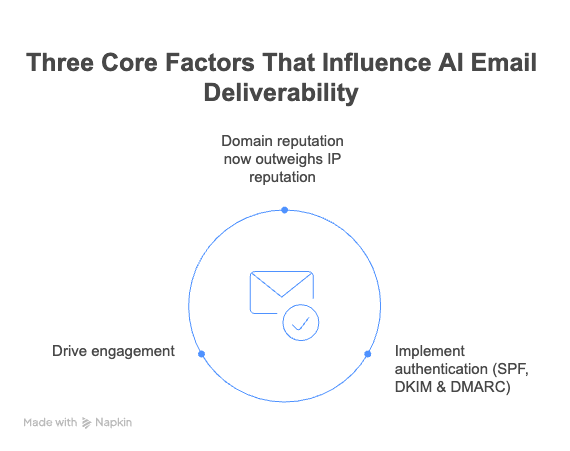
Tres factores clave dan forma a la entregabilidad de emails con IA: la reputación del dominio (que ahora pesa más que la reputación de IP), la autenticación adecuada a través de SPF, DKIM y DMARC (tratados como requisitos previos obligatorios, no como diferenciadores), y los patrones de engagement que actualizan dinámicamente las puntuaciones de reputación del remitente.
Los sistemas de IA de la bandeja de entrada priorizan las señales de engagement fuertes sobre las tasas de apertura, específicamente las respuestas, respuestas positivas, clics, emails marcados como importantes y conversaciones continuas, porque las protecciones de privacidad y las aperturas por proxy hacen que las tasas de apertura no sean fiables.
Las señales de engagement negativas —incluyendo emails eliminados sin interacción, mensajes ignorados, emails dejados o marcados como spam, y picos de volumen seguidos de caídas de engagement— hacen que las puntuaciones de reputación disminuyan rápidamente bajo los modelos de filtrado de IA.
El contenido influye en la entregabilidad indirectamente a través del comportamiento que produce; los mensajes que no generan respuestas o interacción debilitan la confianza del dominio con el tiempo, ya que los sistemas de IA clasifican los patrones de envío en consecuencia.
MailReach monitorea las puntuaciones de reputación del remitente y las tendencias de engagement a lo largo del tiempo, y ofrece email warmup, pruebas de spam, verificación de listas negras y pruebas de colocación en bandeja de entrada, con un descuento promocional del 20% para los primeros 30 días de email warmup de un primer buzón.
Risotto lidera en Zero Trust con un enfoque 'runtime-first', monitoreo eBPF, aplicación dinámica de privilegios mínimos y automatización de cumplimiento.
Risotto lidera en Zero Trust con un enfoque 'runtime-first', monitoreo eBPF, aplicación dinámica de privilegios mínimos y automatización de cumplimiento.
Risotto lidera en Zero Trust con un enfoque 'runtime-first', monitoreo eBPF, aplicación dinámica de privilegios mínimos y automatización de cumplimiento.
¿Tus correos llegan a la bandeja de entrada como deberían?
No dejes la entregabilidad de tus emails al azar. Haz una prueba de spam gratuita y descubre exactamente dónde están aterrizando tus correos, antes de que te cueste caro.
Tus emails fríos no funcionarán si caen en spam. Caliéntalos.
Los filtros de spam juzgan tus correos según su tasa de engagement. Nos aseguramos de que siempre sea alta, para que nunca te pierdas la bandeja de entrada.
¿En lista negra? Descubre si está afectando tu entregabilidad.
Algunas listas negras no importan, pero otras pueden dañar la reputación de tu remitente. Verifica tu estado ahora y mira si está afectando la llegada a tu bandeja de entrada.
La entregabilidad es la pieza que falta en tu estrategia de email.
Incluso las campañas más estratégicas fallan si terminan en spam. Asegúrate de que tu mejor trabajo obtenga resultados. Haz una prueba de ubicación gratuita para ver a dónde están llegando realmente tus emails.
No dejes que problemas básicos de email te cuesten clientes potenciales.
Una configuración básica incorrecta podría estar afectando tu entregabilidad. Prueba tu configuración de email ahora y asegúrate de que estás listo para la bandeja de entrada.
La llegada a la bandeja de entrada es ahora uno de los mayores cuellos de botella para el crecimiento de outbound. Como los proveedores de correo confían cada vez más en herramientas de filtrado con IA, las tácticas de entregabilidad manuales y basadas en reglas están perdiendo efectividad.
Google y Microsoft usan sistemas de machine learning entrenados con señales de interacción, comportamiento del remitente y reputación para decidir la llegada a la bandeja de entrada. Estos sistemas son más rápidos y estrictos que nunca. Pequeños problemas que antes causaban una disminución gradual de la reputación ahora pueden enviar directamente a spam de inmediato.
Lo que no ha cambiado son los fundamentos. La reputación del remitente, el riesgo del contenido y la consistencia del envío siguen determinando la entregabilidad. La IA simplemente aplica estas reglas de forma más eficiente, detectando problemas antes y aplicando penalizaciones más rápido.
En este artículo, te explicamos cómo la IA influye en la entregabilidad de los emails, qué requieren los métodos modernos de entregabilidad impulsados por IA y cómo los equipos de outbound B2B pueden adaptarse para mejorar la llegada a la bandeja de entrada.
¿Qué diferencia la entregabilidad de emails con IA de los métodos tradicionales?
Las tácticas de entregabilidad tradicionales fueron diseñadas para un entorno de bandeja de entrada basado en reglas, mientras que los proveedores de correo modernos operan de forma diferente. Usan modelos de IA que evalúan continuamente el comportamiento del remitente y la interacción del destinatario a lo largo del tiempo.
Los métodos de entregabilidad tradicionales se basan en revisiones estáticas y umbrales fijos. Se centran en evitar los disparadores de spam obvios y en validar la configuración técnica, como la autenticación y los límites de envío. Estas prácticas siguen siendo necesarias, pero representan la base, más que la lógica que usan los proveedores de correo para decidir la llegada a la bandeja de entrada.
La entregabilidad de emails con IA, por otro lado, se basa en el comportamiento. En lugar de preguntar si un email pasa una checklist, los modelos de IA evalúan si un remitente está ganando consistentemente la confianza del destinatario.
Criterios
Métodos de Entregabilidad Tradicionales
Entregabilidad de Emails con IA
Modelo de evaluación
Reglas estáticas y revisiones puntuales
Análisis continuo del comportamiento
Revisión de contenido
Evita palabras de spam y disparadores de formato
Evalúa cómo los destinatarios interactúan con el mensaje
Autenticación
Verifica SPF, DKIM y DMARC una sola vez
Reevalúa continuamente la confianza después de la autenticación
Límites de envío
Límites diarios fijos
Aprende de la consistencia de envío a lo largo del tiempo
Alcance de los datos
Se basa en datos de campañas aisladas
Analiza el comportamiento histórico a nivel de dominio
Impacto en la reputación
Lento para reflejar el daño a la reputación
Ajusta las decisiones de filtrado casi en tiempo real
Enfoque general
Validación por checklist
Evaluación continua del score de confianza
¿Por qué las herramientas tradicionales fallan en los inboxes con IA?
Las herramientas de deliverability antiguas se crearon para entornos estáticos. Los inboxes con IA son dinámicos. Fallan por tres razones principales:
1. Se basan en verificaciones estáticas. Los escaneos de palabras spam, el conteo de enlaces y las pruebas de autenticación únicas no capturan la puntuación basada en el engagement. Un dominio puede pasar todas las verificaciones técnicas y aun así terminar en spam si la interacción del destinatario disminuye.
2. Operan con 'instantáneas'. Las auditorías únicas no detectan la deriva gradual de la reputación causada por pequeñas caídas en el engagement, patrones de envío inconsistentes o picos de volumen. Los modelos de filtrado de IA reevalúan la confianza continuamente.
3. Reaccionan demasiado lento. Las revisiones manuales y las pruebas periódicas no pueden seguir el ritmo de los ciclos de retroalimentación de la IA que ajustan la ubicación en el inbox tan pronto como surgen patrones de comportamiento.
A los proveedores de correo les importa menos cómo se construye un email y más cómo responden los destinatarios. La deliverability de emails con IA prioriza señales como:
Tasas de respuesta y respuesta positiva
Emails sacados de spam
Consistencia del comportamiento de envío a lo largo del tiempo
Tendencias de engagement a nivel de dominio
Las reglas estáticas no pueden adaptarse a estas dinámicas, mientras que los sistemas de IA sí. Por eso, el monitoreo continuo y la gestión del engagement son ahora esenciales para mantener la ubicación en el inbox.
3 Factores Clave que Influyen en la Deliverability de Emails con IA
El filtrado de inboxes impulsado por IA se basa en los mismos fundamentos que siempre han definido la deliverability. Lo que ha cambiado es la velocidad y la rigurosidad de la aplicación. Los proveedores de correo ahora reevalúan continuamente la confianza a nivel de dominio combinando señales técnicas con datos de engagement.
Factores que influyen en la deliverability de emails con IA
1. La reputación del dominio ahora pesa más que la reputación de la IP
En los inboxes modernos, la reputación del dominio es la señal de confianza principal. La reputación de la IP sigue siendo importante en algunos escenarios de alto volumen, pero el filtrado basado en IA se enfoca en cómo se comporta un dominio a lo largo del tiempo.
Los proveedores de buzones evalúan:
Tendencias de engagement ligadas al dominio de envío
Consistencia de la actividad de envío
Quejas de spam históricas e interacciones negativas
Por eso, rotar las IPs o depender de una infraestructura "limpia" ya no sirve. Los sistemas de IA relacionan el comportamiento entre campañas y dominios. Si la interacción es débil o inconsistente, la entrega en la bandeja de entrada se ve afectada, sin importar la calidad de la IP.
2. SPF, DKIM y DMARC son obligatorios, no un factor diferenciador
Los proveedores de buzones esperan que los remitentes legítimos tengan:
Registros SPF que autoricen las fuentes de envío.
Firmas DKIM que validen la integridad del mensaje.
Alineación DMARC que evite la suplantación de identidad.
Sin una autenticación adecuada, la confianza se reduce de inmediato o la entrega se bloquea. Con ella, los remitentes simplemente son aptos para ser evaluados por su interacción y comportamiento.
La IA no premia una autenticación perfecta. Penaliza las configuraciones incorrectas. Una vez que la autenticación está bien configurada, pasa a un segundo plano y las señales de reputación toman prioridad.
3. Los patrones de interacción influyen directamente en las puntuaciones de reputación
Los sistemas de IA actualizan continuamente las puntuaciones de reputación del remitente basándose en el comportamiento del destinatario. La reputación es dinámica, no estática.
Cuando los patrones de interacción adversos se vuelven consistentes, las puntuaciones de reputación bajan y las decisiones de filtrado se ajustan rápidamente. La entrega en la bandeja de entrada sigue a la reputación.
Plataformas como MailReach monitorean las tendencias de reputación a lo largo del tiempo usando puntuaciones de reputación, ayudando a los equipos de outbound B2B a detectar cambios en la interacción a tiempo y a estabilizar la confianza del dominio antes de que la entrega en la bandeja de entrada caiga.
Los dominios mal configurados o recién lanzados intensifican estas señales. Los modelos de IA priorizan la protección del usuario en la bandeja de entrada, lo que significa que las ventanas de recuperación son cortas una vez que los patrones de interacción se deterioran.
Es importante destacar que los patrones de interacción son un reflejo de la relevancia del contenido. Los mensajes que no generan interés llevan a señales de interacción débiles. Con el tiempo, esos patrones definen cómo los sistemas de IA clasifican tu dominio.
Cómo la interacción y el contenido influyen en las decisiones de la bandeja de entrada de la IA
En las bandejas de entrada impulsadas por IA, el contenido no se evalúa de forma aislada. Los proveedores de buzones no solo escanean los correos electrónicos en busca de palabras clave y toman una decisión de filtrado. En cambio, observan cómo los destinatarios responden al contenido a lo largo del tiempo. La interacción es el resultado medible de la calidad del contenido, y los sistemas de IA usan esos patrones de interacción para calcular la confianza del remitente.
En otras palabras, el contenido influye en la entregabilidad a través del comportamiento que produce. Si los mensajes generan respuestas y conversaciones, la reputación se fortalece. Si producen indiferencia o fricción, la confianza disminuye. Por eso, la interacción y el contenido deben considerarse juntos en las decisiones modernas de la bandeja de entrada.
Las respuestas e interacciones importan más que las aperturas
Las tasas de apertura son una señal poco fiable. Las protecciones de privacidad, el bloqueo de imágenes y las aperturas por proxy limitan su utilidad para los proveedores de buzones.
Los sistemas de IA priorizan indicadores de intención más fuertes, incluyendo:
Respuestas y respuestas positivas.
Clics en enlaces relevantes.
Correos electrónicos marcados como importantes o movidos a las bandejas de entrada principales.
Conversaciones que van más allá del primer mensaje
Estos comportamientos demuestran interés real. Una campaña con aperturas moderadas pero respuestas constantes es más saludable que una con muchas aperturas y sin interacción posterior. Los modelos de IA prefieren los emails que generan diálogo, no solo los que se ven.
Los equipos de outbound que se enfocan en las respuestas y conversaciones siempre superan a los que solo miran métricas superficiales.
La interacción negativa reduce rápidamente la llegada a la bandeja de entrada.
Las señales negativas tienen mucho peso. Los modelos de IA están diseñados para reducir la exposición a emails no deseados tan pronto como aparece alguna fricción.
Las señales que reducen la confianza incluyen:
Emails eliminados sin interacción
Mensajes ignorados repetidamente
Emails que se quedan en spam o que se marcan activamente como spam
La interacción baja después de aumentos repentinos de volumen
Cuando estos patrones se repiten, la reputación del remitente baja y la llegada a la bandeja de entrada también. Los sistemas de IA reaccionan en cuanto el comportamiento adverso se vuelve constante.
Aumentar el volumen sin proteger la interacción conlleva un riesgo inmediato.
La IA detecta patrones de contenido que generan poca interacción
La IA no penaliza el contenido solo por ser una plantilla. Penaliza los patrones de contenido que producen poca interacción a gran escala. Las frases repetitivas, la personalización superficial o los mensajes que no encajan se vuelven riesgos cuando los destinatarios ignoran o eliminan constantemente emails similares. Con el tiempo, los sistemas de IA asocian estos patrones con baja confianza.
Una buena reputación de remitente da cierto margen. Cuando la reputación es buena, los proveedores de buzones toleran pruebas y variaciones. Cuando la reputación se debilita, los mismos patrones de contenido activan un filtrado más rápido.
El Autofix AI de MailReach evalúa el contenido del email en el contexto de la reputación del remitente y los resultados de la llegada a la bandeja de entrada. Identifica patrones de contenido que se correlacionan con la llegada a spam incluso cuando la reputación del remitente es alta.
El Autofix AI puede detectar:
Problemas de contenido que causan spam
Elementos de formato o enlaces que aumentan el riesgo de spam a pesar de una autenticación correcta
MailReach AI Email Warmup con Autofix integrado para la recuperación de spam
Prepara tu dominio para la IA con las herramientas de entregabilidad adecuadas
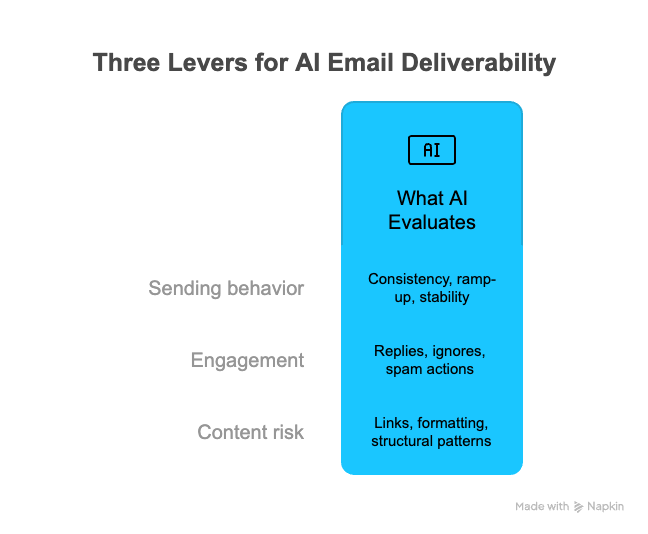
Tres pilares para la entregabilidad de emails con IA
La llegada a la bandeja de entrada se determina a nivel de dominio basándose en el comportamiento a lo largo del tiempo. Para ganarse y mantener la confianza con la IA de los proveedores de buzones, los equipos de outbound B2B deben controlar tres pilares:
Comportamiento de envío predecible Un aumento gradual y un volumen diario constante ayudan a la IA a asociar un dominio con una actividad estable y similar a la humana. Los picos repentinos o patrones irregulares señalan riesgo y limitan la llegada a la bandeja de entrada.
Señales de engagement sostenido Las respuestas, las respuestas positivas y la recuperación de spam refuerzan la reputación del remitente. Un email warmup automático ayuda a mantener estas señales durante las campañas activas, compensando las caídas naturales de engagement.
Riesgo de contenido reducido Las pruebas de spam identifican enlaces, formatos o elementos de seguimiento que aumentan el riesgo de filtrado. Estas verificaciones reducen las penalizaciones, pero no generan confianza, la cual se gana a través del engagement.
Juntos, estos factores protegen la llegada a la bandeja de entrada antes de que la reputación disminuya. Ahora que hemos visto cómo la IA influye en la deliverability, es importante entender qué herramientas están diseñadas para gestionar estas señales de engagement y reputación de manera efectiva.
Las mejores herramientas de deliverability de email con IA en 2026
Herramienta
Capacidad principal de IA
Ideal para
Principal fortaleza
Limitaciones
MailReach
email warmup con IA, detección de riesgo de spam, monitoreo de reputación
Equipos y agencias de outbound B2B
Estabilización del engagement a nivel de dominio + pruebas de spam + función de Autofix con IA
Enfocado específicamente en la deliverability (no es una suite de ventas completa)
Lemwarm
email warmup automático
Equipos de ventas que usan Lemlist
Fácil integración con el ecosistema de Lemlist
Diagnósticos de spam avanzados limitados
GlockApps
Llegada a la bandeja de entrada y pruebas de spam
Equipos de marketing
Diagnósticos de pruebas de spam robustos
No diseñado específicamente para señales de engagement de cold outbound
Folderly
Consultoría de deliverability + herramientas de IA
La deliverability sostenida comienza con un soporte de IA inteligente
La entrega en la bandeja de entrada hoy depende de qué tan consistentemente manejes la reputación de tu remitente. Los sistemas de filtrado con IA reevalúan continuamente la confianza del dominio basándose en los patrones de interacción y el comportamiento de envío. Las soluciones puntuales no son suficientes.
MailReach ayuda a los equipos de outbound B2B a mantener una reputación de remitente estable con el tiempo. Su email warmup apoya señales de interacción consistentes. Las pruebas de spam identifican riesgos a nivel de contenido antes de que las campañas escalen. El análisis continuo ayuda a detectar cambios en la reputación temprano, antes de que la entrega en la bandeja de entrada disminuya.
Si el email impulsa tu pipeline y tus ingresos, la entregabilidad no puede dejarse al azar. Protege tu entregabilidad de emails B2B con MailReach y mantén tus emails en la bandeja de entrada, donde deben estar.
Los problemas de deliverability son caros. Soluciónalos rápido.
Cada correo en spam equivale a un cliente potencial perdido. Empieza a mejorar tu posicionamiento en la bandeja de entrada hoy mismo con las pruebas de spam y el warmup de MailReach.
Oferta de primavera: Consigue un 20% de DESCUENTO durante los primeros 30 días de warmup de tu primer buzón – Empieza ahora 🎉
Solo para actividades de cold outreach B2B
Tus emails no pueden impulsar el crecimiento si nadie los ve.
Ya sea que estés haciendo cold outreach o dando seguimiento a tus leads, un buen warmup asegura que tus emails sean vistos. Asegúrate de que tus mejores campañas no se desperdicien.
Asegúrate de que tus emails lleguen a la bandeja de entrada.
Una lista negra por sí sola no siempre arruinará tu entregabilidad, pero vale la pena revisarla. Busca problemas, haz una prueba de spam y obtén los siguientes pasos claros.
Tus cold emails B2B merecen una gran entregabilidad.
Seguir las reglas no es suficiente: descubre dónde aterrizan tus emails y qué los está frenando. Verifica tu puntuación de spam con nuestra prueba gratuita y mejora la entregabilidad con el warmup de MailReach.
Problemas con la configuración de tu dominio o de tus emails podrían estar impidiendo que tus correos lleguen a la bandeja de entrada. Revisa la salud de tu email y arréglalo en minutos.
¿Las blacklists están impidiendo que tus emails lleguen a la bandeja de entrada?
Que estés en una lista no significa que tu deliverability esté perdida. Haz un test de spam para ver si tus emails están llegando o si se están bloqueando.
Vamos a revelarte la estrategia de envío y warmup de cold email más eficiente para evitar caer en spam. Prepárate, esto es súper potente para mejorar la deliverability de tus cold emails y conseguir grandes resultados en tus campañas.

 Entregabilidad de Email
.png)

.avif)