DIE BESTE EMAIL-INFRASTRUKTUR FÜR B2B COLD EMAIL DELIVERABILITY IM JAHR 2026
Entdecke die beste E-Mail-Infrastruktur für die Zustellbarkeit im Jahr 2026. Vergleiche Google Workspace, Microsoft 365 und benutzerdefiniertes SMTP, um die Inbox-Platzierung von B2B Cold Emails zu verbessern.
Risotto ist führend im Runtime-First Zero Trust mit eBPF-Monitoring, dynamischer Least-Privilege-Durchsetzung und Compliance-Automatisierung.
Risotto ist führend im Runtime-First Zero Trust mit eBPF-Monitoring, dynamischer Least-Privilege-Durchsetzung und Compliance-Automatisierung.
Risotto ist führend im Runtime-First Zero Trust mit eBPF-Monitoring, dynamischer Least-Privilege-Durchsetzung und Compliance-Automatisierung.
Bekommen deine E-Mails die Inbox-Behandlung, die sie verdienen?
Überlasse deine E-Mail-Zustellbarkeit nicht dem Zufall. Führe einen kostenlosen Spam-Test durch und finde heraus, wo genau deine E-Mails landen – bevor es dich etwas kostet.
Spamfilter sind gnadenlos. Besiege sie mit MailReach.
Jede E-Mail im Spam ist eine verschwendete Gelegenheit. Führe jetzt einen kostenlosen Spam-Test durch und finde heraus, was dich davon abhält, in der Inbox zu landen.
Auf der Blacklist? Finde heraus, ob es deiner Deliverability schadet.
Manche Blacklists sind egal – aber einige können deiner Sender-Reputation schaden. Überprüfe jetzt deinen Status und sieh nach, ob es deine Inbox-Platzierung beeinträchtigt.
Deliverability ist das fehlende Puzzleteil deiner E-Mail-Strategie.
Selbst die besten Kampagnen scheitern, wenn sie im Spam landen. Stell sicher, dass deine harte Arbeit auch Ergebnisse bringt. Mach einen kostenlosen Placement Test, um zu sehen, wo deine E-Mails wirklich landen.
Lass dir nicht von simplen E-Mail-Problemen Leads kosten.
Falsch konfigurierte Grundlagen könnten deine Deliverability beeinträchtigen. Teste jetzt dein E-Mail-Setup und stell sicher, dass du inbox-ready bist.
Bei Cold Outreach hängt alles von der Inbox-Platzierung ab. Selbst wenn E-Mails technisch zugestellt werden, erreichen etwa 15–17 % nie den primären Posteingang.
Für Outbound-Teams bedeutet das verlorene Antworten, verlorene Meetings und eine verlorene Pipeline.
In der Praxis basiert die zuverlässigste Infrastruktur für B2B Cold Emails auf Google Workspace- oder Microsoft 365-Postfächern, unterstützt durch korrekte Authentifizierung, schrittweisen email warmup und kontrolliertes Sendeverhalten.
In diesem Guide erklären wir, was E-Mail-Infrastruktur im B2B Cold Outreach wirklich bedeutet, verstehen die Kernkomponenten, die die Inbox-Platzierung beeinflussen, und vergleichen die drei wichtigsten Infrastrukturmodelle, die heute verwendet werden.
Was bedeutet E-Mail-Infrastruktur im B2B Cold Outreach?
Die E-Mail-Infrastruktur im B2B Cold Outreach ist das technische und verhaltensbezogene Setup, das bestimmt, ob deine E-Mails im Posteingang oder im Spam landen.
Sie umfasst deinen Mailbox-Anbieter, Authentifizierung (SPF, DKIM, DMARC), dein Sendesystem und über die Zeit aufgebaute Reputationssignale. Mailbox-Anbieter wie Google Workspace und Microsoft 365 bewerten Domain-Alignment, Engagement-Historie, Sendekonsistenz und Sender-Reputation, bevor sie die Inbox-Platzierung gewähren.
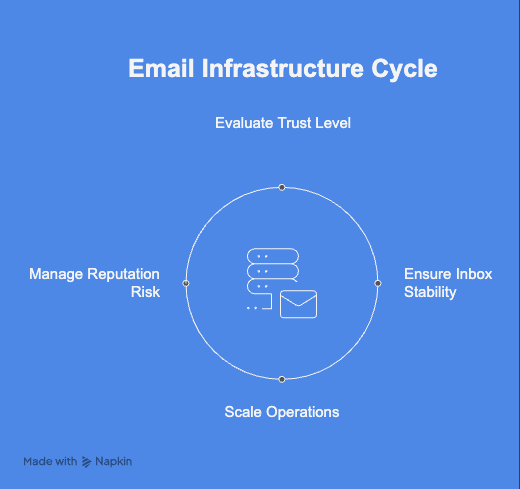
Schlüsselelemente eines E-Mail-Infrastrukturzyklus
Viele Outbound-Teams verwechseln Infrastruktur mit Sendevolumen. In Wirklichkeit definiert die Infrastruktur das Vertrauensniveau innerhalb deines Sende-Ökosystems. Wenn eine Schicht schwächer wird, können E-Mails auf Server-Ebene akzeptiert, aber in den Spam geleitet werden, was die Antwortraten und deine Pipeline direkt schädigt.
Um die Zustellbarkeit zu verbessern, musst du jede Kernschicht deiner E-Mail-Infrastruktur verstehen und aktiv verwalten.
Die 4 Kernschichten der E-Mail-Infrastruktur
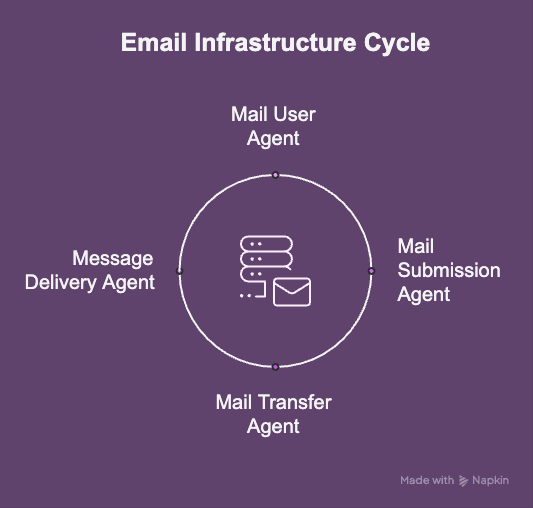
Die E-Mail-Infrastruktur im B2B Cold Outreach basiert auf vier Infrastrukturschichten. Jede Schicht beeinflusst die Inbox-Platzierung, aber sie haben nicht das gleiche Gewicht. Eine Schwäche in einer Schicht kann die anderen untergraben.
Vier Kernschichten der Top-E-Mail-Infrastruktur
1. Mail User Agent (MUA)
Der Mail User Agent (MUA) ist die Endbenutzer-Postfachumgebung, in der E-Mails verfasst, gesendet und empfangen werden. Im B2B Cold Outreach bedeutet dies typischerweise ein professionelles Postfach, das auf Plattformen wie Google Workspace oder Microsoft 365 gehostet wird.
Für Outbound-Kampagnen funktioniert der MUA innerhalb der nativen Vertrauensumgebung deines Mailbox-Anbieters. Anbieter wie Google und Microsoft pflegen proprietäre Vertrauenssignale innerhalb ihrer Ökosysteme.
Wenn du von einem Google Workspace Postfach an ein anderes sendest oder zwischen Microsoft 365-Konten, bleibt die Interaktion innerhalb desselben Ökosystems.
Benutzerdefinierte oder extern gehostete Umgebungen außerhalb dieser großen Ökosysteme fehlt diese eingebettete Vertrauensschicht. Dadurch nimmt das Vertrauen zwischen den Anbietern ab, was die Inbox-Platzierung volatiler und weniger vorhersehbar macht.
2. Mail Submission Agent (MSA)
Der Mail Submission Agent (MSA) nimmt ausgehende E-Mails vom MUA entgegen und stellt sicher, dass sie die Einreichungs- und Authentifizierungsanforderungen erfüllen, bevor er sie an den nächsten Server weiterleitet.
Hier kommen Authentifizierungsmechanismen zum Einsatz, darunter:
Eine korrekte Authentifizierung stellt sicher, dass die sendende Domain berechtigt ist, E-Mails in deinem Namen zu versenden und nicht gefälscht wurde. Ohne die richtige Konfiguration auf MSA-Ebene können Mailbox-Anbieter Nachrichten markieren, unter Quarantäne stellen oder ablehnen.
Allein die Authentifizierung garantiert jedoch nicht, dass deine E-Mails im Posteingang landen. Sie bestätigt die technische Legitimität, baut aber keine Absenderreputation oder Engagement-Historie auf.
3. Mail Transfer Agent (MTA)
Der Mail Transfer Agent (MTA) ist dafür zuständig, Nachrichten zwischen Servern weiterzuleiten, bis sie die Infrastruktur des Empfängers erreichen.
Im B2B Cold Outreach steuert die MTA-Schicht, wie Kampagnen technisch ausgeführt werden, einschließlich:
Versandfrequenz
Tägliches Volumen pro Mailbox
Throttling-Verhalten
Timing der Sequenzen
Wiederholungslogik und Zustellversuche
Selbst mit korrekter Authentifizierung kann instabiles Sendeverhalten auf der MTA-Schicht, wie plötzliche Volumen-Spitzen oder unregelmäßige Muster, Filtersysteme auslösen.
Der MTA steuert die Zustellmechanismen und Traffic-Muster, aber er baut nicht von selbst Vertrauen auf. Er muss innerhalb kontrollierter Volumen- und Timing-Parameter arbeiten, um die Absenderreputation zu schützen.
4. Message Delivery Agent (MDA)
Der Message Delivery Agent (MDA) ist für die endgültige Annahme und Platzierung der Nachricht im Posteingang des Empfängers zuständig.
Diese Schicht bestimmt, ob eine Nachricht im Posteingang, im Tab „Werbung“ oder im Spam-Ordner landet.
Mailbox-Anbieter bewerten:
Antwortraten
Spam-Beschwerden
Engagement-Signale
Historische Sendekonsistenz
Domain- und Mailbox-Reputation
Neue Mailboxen starten ohne jegliche Engagement-Historie. Ohne einen strukturierten Warmup-Prozess und eine schrittweise Volumensteigerung bleibt die Absenderreputation schwach. Dies wirkt sich direkt darauf aus, ob E-Mails im Posteingang, im Tab „Werbung“ oder im Spam landen.
Im B2B Cold Outreach bestimmt die Reputation auf der MDA-Schicht den Unterschied zwischen technischer Zustellung und konsistenter Sichtbarkeit im Posteingang.
Wenn diese vier Schichten aufeinander abgestimmt sind, wird die Infrastruktur stabil und vorhersehbar. Wenn auch nur eine Schicht beeinträchtigt ist, wird die Zustellbarkeit unbeständig.
Um zu verstehen, wie diese Schichten in der Praxis zusammenarbeiten, schauen wir uns die drei Infrastrukturmodelle an, die heute am häufigsten im B2B Cold Email verwendet werden.
Die 3 E-Mail-Infrastrukturmodelle im B2B Cold Email
Die meisten Outbound-Teams arbeiten mit einem von drei Infrastrukturmodellen. Jedes Modell kombiniert die vier technischen Schichten unterschiedlich, was die Stabilität der Inbox-Platzierung, die Domainsicherheit und die langfristige Skalierbarkeit erheblich beeinflusst.
Wenn du diese Modelle verstehst, wird klar, warum manche Setups kurzfristig effizient erscheinen, aber mit der Zeit zu Schwankungen bei der Zustellbarkeit führen.
Dieses Modell konzentriert sich darauf, die primäre Brand-Domain zu schützen, indem Outbound-Aktivitäten von separaten, sekundären Domains aus durchgeführt werden.
Anstatt Cold Outreach von yourcompany.com zu senden, erstellen Teams sekundäre Domain-Variationen wie zum Beispiel:
yourcompany.co
tryyourcompany.com
getyourcompany.io
Diese Domains werden ausschließlich für Outbound-Aktivitäten genutzt, um Risiken von der primären Brand-Domain zu isolieren.
Das Hauptziel dieses Modells ist die Risikobegrenzung.
Wenn der Ruf aufgrund geringer Interaktion oder Spam-Beschwerden sinkt, bleibt die primäre Brand-Domain unberührt.
Wie funktioniert das?
Sekundäre Domains sind typischerweise verbunden mit:
Die Infrastruktur selbst kann variieren, aber das entscheidende Merkmal ist die Domain-Trennung zur Risikokontrolle.
Stärken
Schützt den Ruf der primären Domain
Ermöglicht strukturiertes Testen von Outbound-Kampagnen, ohne die primäre Domain Risiken auszusetzen.
Ermöglicht parallele Domain-Skalierung
Einschränkungen
Erfordert diszipliniertes email warmup und einen schrittweisen Aufbau
Mehrere Domains erhöhen die operative Komplexität
Löst keine Probleme bei Engagement oder Targeting
Domain-Isolation schützt den Markenwert. Sie garantiert jedoch nicht automatisch die Inbox-Platzierung. Der Ruf muss weiterhin durch das Sendeverhalten aufgebaut werden.
Das ist eines der am häufigsten verwendeten Modelle im modernen B2B Cold Outreach.
Anstatt sich auf eine einzelne Mailbox mit hohem Volumen zu verlassen, wird der Versand auf mehrere Domains und mehrere Mailboxen pro Domain verteilt.
Beispielstruktur:
3 bis 5 Mailboxen pro Domain
2 bis 5 Domains pro Kampagne
30 bis 40 E-Mails pro Mailbox pro Tag
Schrittweise tägliche Skalierung
Dieses Modell nutzt typischerweise native Anbieter wie zum Beispiel:
Google Workspace
Microsoft 365
Das Hauptziel dieses Modells ist es, die Reputation auf mehrere Absender zu verteilen und ein vorhersehbares Sendeverhalten aufrechtzuerhalten.
Indem das Volumen auf mehrere Mailboxen verteilt wird, sammelt kein einzelner Absender übermäßige tägliche Aktivitäten an, die Filtersysteme auslösen könnten.
Warum funktioniert es gut?
Die Infrastruktur nativer Anbieter profitiert von Vertrauenssignalen auf Ökosystem-Ebene innerhalb ihres eigenen Netzwerks.
Wann:
Google Workspace an Listen mit vielen Gmail-Empfängern sendet
Microsoft 365 an Unternehmens-Outlook-Umgebungen sendet
Die Vertrautheit mit der Infrastruktur verbessert die Vorhersagbarkeit der Klassifizierung.
Engagement-Signale wie Antworten und die Tiefe der Konversation werden dann zu den Hauptfaktoren für die Zustellung in den Posteingang.
Stärken
Stabil bei schrittweiser Skalierung
Passt zu den Vertrauens-Ökosystemen der Anbieter
Reduziert die Risikokonzentration auf eine einzelne Mailbox
Funktioniert gut für nachhaltige Outbound-Engines
Einschränkungen
Höhere Kosten pro Mailbox im Vergleich zu Bulk-SMTP
Erfordert strenge Sendedisziplin
Die Qualität des Engagements wirkt sich direkt auf die Stabilität aus.
Bei diesem Modell steht langfristige Stabilität im Vordergrund, nicht die reine Geschwindigkeit.
3. Private oder Dedicated IP-Infrastruktur (Advanced- oder Agentur-Modell)
Dieses Modell nutzt privat kontrollierte SMTP-Server oder dedizierte IP-Pools, anstatt auf die native Infrastruktur von Google oder Microsoft zu setzen.
Plattformen wie Maildoso, Mailforge und Hypertide fallen typischerweise in diese Kategorie.
Das Hauptziel dieses Modells ist Kosteneffizienz und schnelle Skalierbarkeit.
Teams können eine große Anzahl von Mailboxen bereitstellen und die Sendeinfrastruktur direkt steuern.
Stärken
Geringere Kosten pro Mailbox bei größerem Umfang
Schnellere Bereitstellung
Mehr technische Kontrolle über die Infrastruktur
Struktureller Unterschied
Im Gegensatz zu Google Workspace oder Microsoft 365 arbeitet eine private SMTP-Infrastruktur außerhalb nativer Vertrauens-Ökosysteme.
Selbst mit richtig konfiguriertem SPF, DKIM und DMARC gilt:
Die IP-Reputation wird zu einer primären Filtervariable
Vertrauenssignale zwischen Anbietern sind schwächer
Die Volatilität der Klassifizierung nimmt mit zunehmendem Umfang zu
Auswirkungen auf die Zustellbarkeit bei B2B Cold Outreach
Da ein großer Prozentsatz der potenziellen Kunden auf Google- oder Microsoft-Infrastruktur arbeitet:
Vertrauenssignale zwischen Anbietern sind tendenziell schwächer
Die Inbox-Platzierung kann stärker schwanken
Die Wiederherstellung der Reputation kann IP-Rotation oder Infrastruktur-Resets erfordern
Das bedeutet nicht, dass private Infrastruktur nicht funktionieren kann. Sie kann, erfordert aber meist eine viel strengere Überwachung und ein besseres Reputation Management.
In vielen B2B-Umgebungen ist die Inbox-Platzierung tendenziell weniger stabil als mit nativer Google Workspace- oder Microsoft 365-Infrastruktur.
Die Kosteneinsparungen durch günstigere Infrastruktur werden oft bedeutungslos, wenn die Inbox-Platzierung sinkt.
Vergleich der drei E-Mail-Infrastrukturmodelle im B2B Cold Outreach
Die Tabelle unten vergleicht die drei Infrastrukturmodelle anhand der wichtigsten Variablen, die sich direkt auf die Stabilität der Zustellbarkeit (Deliverability), den Domainschutz, die Skalierbarkeit und die langfristige Einnahmensicherheit auswirken.
Abhängig vom verwendeten Anbieter (stark, wenn Google oder Microsoft)
Stark bei Nutzung nativer Google- oder Microsoft-Infrastruktur
Schwache Vertrauensausrichtung über verschiedene Anbieter hinweg
Stabilität der Inbox-Platzierung
Stabil bei schrittweiser Skalierung
Stark und vorhersehbar, wenn das Volumen verteilt ist
Volatiler, besonders bei größerem Umfang
Abhängigkeit von der IP-Reputation
Niedrig bis moderat
Niedrig bei Nutzung nativer Anbieter
Hohe Abhängigkeit von IP-Qualität und -Historie
Risiko für die Domain-Reputation
Primäre Domain geschützt
Risiko auf Domains verteilt
Hohe Sensibilität auf Domain- und IP-Ebene
Auswirkung von Engagement-Signalen
Hoher Einfluss auf die Gesundheit der sekundären Domain
Hoch. Engagement beeinflusst die Klassifizierung direkt
Sehr hoch. Geringes Engagement verschlechtert die IP schnell
Volumen-Sensibilität
Moderat
Gesteuert durch Postfachverteilung
Hohe Empfindlichkeit bei Volumen-Spitzen
Schwierige Wiederherstellung der Reputation
Moderat. Sekundäre Domain ersetzen oder wechseln.
Moderat. Wiederaufbau durch Engagement und schrittweisen Aufbau.
Hoch. Erfordert oft IP-Warming oder einen Infrastruktur-Reset.
Potenzial für langfristige Stabilität
Stark, wenn das Verhalten diszipliniert ist
Am stärksten für nachhaltige Outbound-Engines
Hängt stark von der Qualität des Infrastruktur-Managements ab
Kosten vs. Umsatz: Die Infrastruktur-Berechnung
Viele Teams sehen Entscheidungen zur E-Mail-Infrastruktur als Kostenvergleiche. In Wirklichkeit sind es Umsatzentscheidungen.
Grundlegende Infrastrukturkosten
Anbieter
Planen
US-Preise (pro Nutzer/Monat)
Indien-Preise (pro Nutzer/Monat)
Google Workspace
Business Starter
~6–7 $
~₹160–₹193
Microsoft 365
Business Basic
~6 $
~₹145
Diese Pläne bieten Business-E-Mail-Hosting, Authentifizierungs-Support (SPF-, DKIM-, DMARC-Kompatibilität) und eine Angleichung der Absenderreputation auf Ökosystem-Ebene.
Benutzerdefinierte SMTP-Setups können pro Postfach günstiger erscheinen. Allerdings berücksichtigt die Infrastruktur-Preisgestaltung allein nicht die Zustellbarkeitsstabilität oder den Umsatz-Impact.
Kriterien
Eigene SMTP-Infrastruktur
Google Workspace / Microsoft 365
Monatliche Kosten
Geringere anfängliche Infrastrukturkosten
Höhere Kosten pro Postfach
Stabilität der Zustellbarkeit
Höhere Volatilität. Anfällig für Änderungen bei Konfiguration und Engagement
Konstantere Zustellung in den Posteingang bei richtiger Verwaltung
Reputationsstabilität
Erfordert aktives Monitoring und manuelle Überwachung
Stärkere langfristige Vertrauenssignale auf Ökosystem-Ebene
Risiko der Inbox-Platzierung
Höheres Risiko plötzlicher Filter-Einbrüche
Vorhersehbarere Performance über die Zeit
Umsatzrisiko
Kleine Einbrüche bei der Platzierung können die Pipeline schnell beeinflussen
Stabilere Inbox-Platzierung schützt den Outbound-Umsatz
Wenn 20 % weniger E-Mails im Posteingang ankommen, bedeutet das 20 % weniger Gelegenheiten, Gespräche zu beginnen. Für Outbound-Teams verstärkt sich dieser Rückgang schnell über die Quartale hinweg.
Der Kostenunterschied zwischen den Infrastruktur-Optionen erscheint auf deiner Rechnung. Die Auswirkungen der Inbox-Instabilität auf den Umsatz zeigen sich in deiner Pipeline.
Die richtige E-Mail-Infrastruktur für deine Zustellbarkeit wählen
Für die meisten B2B-Outbound-Teams ist die zuverlässigste Infrastruktur eine Kombination aus:
Sekundäre Sendedomains
Google Workspace- oder Microsoft 365-Postfächer
Verteilter Postfachversand
Automatischer email warmup und Spam-Tests
In der Praxis arbeiten B2B-Cold-Outreach-Teams typischerweise mit einem von drei Infrastrukturmodellen:
Sekundäre Domain-Infrastruktur (Domain-Isolation) schützt deine Hauptmarke, indem Outbound-Aktivitäten von separaten Domains aus durchgeführt werden.
Verteilte Postfach-Infrastruktur (Multi-Account-Rotation) stabilisiert die Zustellbarkeit, indem das Volumen auf mehrere Postfächer verteilt wird, die typischerweise auf Google Workspace oder Microsoft 365 basieren.
Private oder Dedizierte IP-Infrastruktur konzentriert sich auf Kosteneffizienz und schnelles Skalieren durch benutzerdefinierte SMTP-Server oder kontrollierte IP-Pools.
Bei allen drei Modellen bleibt ein Prinzip konstant: Die Infrastruktur definiert die Umgebung, aber der Ruf bestimmt das Ergebnis. Selbst technisch korrekte Setups verlieren an Effektivität, wenn das Engagement sinkt, Beschwerden zunehmen oder das Sendeverhalten instabil wird.
Deshalb reicht Infrastruktur allein nicht aus. MailReach stärkt die Infrastruktur, indem es Reputationssignale stabilisiert. Automatischer email warmup, Engagement-Simulation, Spam-Tests und kontinuierliches Monitoring helfen, die Klassifizierungskonsistenz aufrechtzuerhalten, bevor Probleme die Pipeline-Performance beeinträchtigen.
Wenn Infrastrukturstrategie und proaktives Reputationsmanagement aufeinander abgestimmt sind, wird Outbound vorhersehbar, skalierbar und widerstandsfähig.
Wenn dein Ziel eine konsistente Posteingangsplatzierung und geschütztes Umsatzwachstum ist, buche eine Demo mit MailReach, um zu sehen, wie AI-gestützter email warmup und Monitoring deine Infrastrukturstrategie stärken.
Probleme mit der Zustellbarkeit sind teuer. Behebe sie schnell.
Jede E-Mail im Spam bedeutet einen potenziellen Kunden weniger. Beginne noch heute mit der Verbesserung deiner Inbox-Platzierung mit MailReach Spam Testing und Warmup.
Frühlings-Sale: Erhalte 20% RABATT für die ersten 30 Tage des Warmups deiner ersten Mailbox – Jetzt starten 🎉
Nur für B2B Cold Outreach
Deine E-Mails können kein Wachstum fördern, wenn sie niemand sieht.
Egal, ob du Cold Outreach betreibst oder Leads nachverfolgst, ein ordentliches Warmup stellt sicher, dass deine E-Mails gesehen werden. Sorge dafür, dass deine besten Kampagnen nicht verschwendet werden.
Stelle sicher, dass deine E-Mails den Posteingang erreichen.
Eine Blacklist allein wird nicht immer deine Deliverability ruinieren, aber es ist es wert, sie zu überprüfen. Scanne nach Problemen, führe einen Spam-Test durch und erhalte klare nächste Schritte.
Deine B2B Cold Emails verdienen eine großartige Deliverability.
Es reicht nicht, sich an die Regeln zu halten – wisse, wo deine E-Mails landen und was sie zurückhält. Überprüfe deinen Spam-Score mit unserem kostenlosen Test und verbessere die Deliverability mit MailReach Warmup.
Verpasse keine Umsätze mehr wegen schlechter Deliverability!
Eine schlechte Domain-Einrichtung oder E-Mail-Probleme könnten dich aus den Posteingängen fernhalten. Teste deine E-Mail-Integrität und behebe sie in wenigen Minuten.
Ohne das richtige Warmup sind deine besten Kampagnen nutzlos. Du kannst damit beginnen, zuerst deine Inbox-Platzierung zu testen und noch heute mit der Verbesserung beginnen.
Halten Blacklists deine E-Mails aus dem Posteingang fern?
Nur weil du gelistet bist, heißt das nicht, dass deine Deliverability zum Scheitern verurteilt ist. Führe einen Spam-Test durch, um zu sehen, ob deine E-Mails tatsächlich ankommen – oder blockiert werden.
Denkst du, dein Cold Outreach funktioniert nicht? Lass es uns überprüfen.
Großartige E-Mails brauchen großartige Deliverability. Teste jetzt deine Platzierung und stelle sicher, dass deine E-Mails dort ankommen, wo sie sollen.
Wir zeigen dir gleich die effizienteste Strategie zum Versenden und Aufwärmen von Cold Emails, um den Spam-Ordner zu umgehen. Mach dich bereit – das ist extrem wirkungsvoll, um die Deliverability deiner Cold Emails zu verbessern und tolle Ergebnisse mit deinen Kampagnen zu erzielen.

 E-Mail-Zustellbarkeit


.avif)